
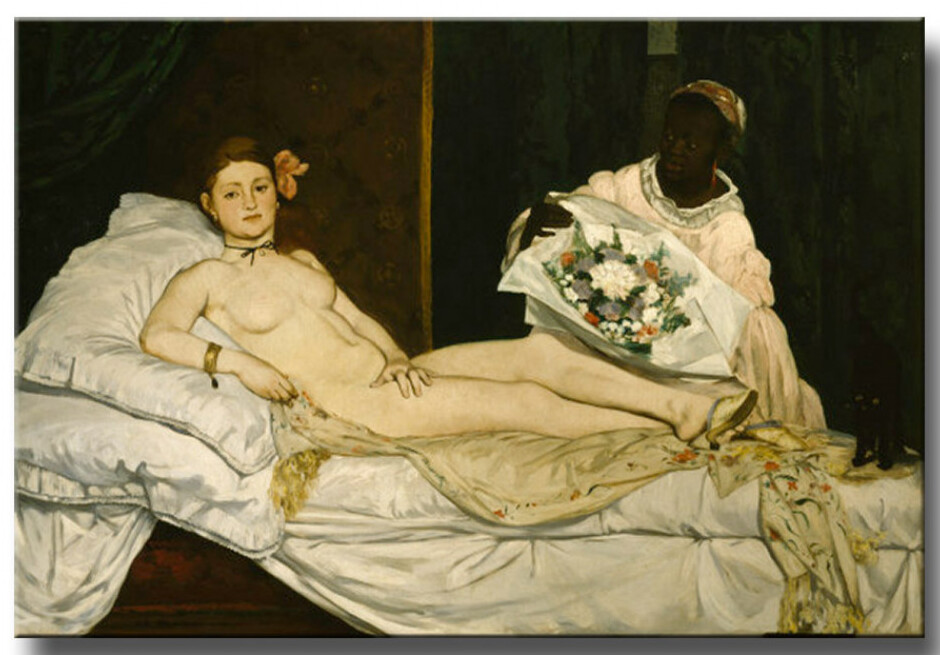

In the heart of Paris, at the Musée d'Orsay, hangs one of the most provocative and revolutionary paintings of the 19th century: Olympia by Édouard Manet. This striking artwork ignited fierce debates when it was unveiled in 1865, challenging the very foundations of traditional representations of the female nude. The anonymous figure depicted in the painting, a resolute courtesan gazing defiantly at the viewer, serves not only as a subject of aesthetic contemplation but also as a bold commentary on the societal norms of the time.

History and Origins
Olympia was created during a period of significant social and political upheaval in France. The mid-19th century was marked by the expansion of the bourgeoisie and a burgeoning middle class, alongside the struggle for women's rights. The painting, with its directness and lack of idealization, reflects the changing attitudes towards sexuality and the role of women in society. Manet, influenced by the Realism movement and the emerging Impressionist style, broke away from the conventions of academic painting, offering a raw and unfiltered glimpse into the life of a courtesan.
The term "Olympia" itself was a common moniker for courtesans in Paris, linking the painting to the city's vibrant yet often hidden underbelly. In contrast to the romanticized nudes of artists like Ingres or Titian, Manet's subject is unapologetically herself—no mythological context to soften her reality. The black cat at her feet symbolizes female sexuality and independence, while the servant presenting a bouquet hints at the transactional nature of her existence.
Art and Architecture
Manet's Olympia is not merely an artwork; it is an artistic manifesto. The style is characterized by bold brushstrokes, a stark contrast of light and dark, and a limited color palette that emphasizes the figure's skin tones against the dark background. This technique not only captures the viewer's attention but also evokes a sense of immediacy and intimacy. The Musée d'Orsay, housed in a former railway station, itself combines Beaux-Arts architecture with modern elements, creating a fitting backdrop for such iconic works.
Beyond Olympia, the museum features masterpieces by other greats like Monet, Van Gogh, and Degas, making it a treasure trove for art lovers. The juxtaposition of styles and eras within its walls provides insight into the evolution of French art, enhancing the appreciation of Manet's audacious contributions.
Local Culture and Traditions
Paris in the 19th century was a crucible of cultural innovation. The Belle Époque era saw a flourishing of arts and literature, exemplified by figures like Zola, Proust, and Maupassant, who explored themes of modernity, sexuality, and the human condition. The city was alive with café culture, where intellectuals gathered to discuss philosophy, politics, and art.
Traditions such as the Fête de la Musique, celebrated every June 21, highlight Paris’s ongoing commitment to artistic expression. This festival transforms streets into stages, showcasing music from every genre, echoing the same spirit of creativity that fueled Manet’s work.
Gastronomy
To truly immerse yourself in Parisian culture, experience its gastronomy. The city is renowned for its diverse culinary offerings, from croissants and baguettes to coq au vin and ratatouille. Pair your meal with a glass of Bordeaux or a refreshing pastis.
For a decadent treat, indulge in a slice of tarte Tatin or a rich éclair from one of the many patisseries that line the streets. Each dish tells a story, much like the art that adorns the walls of the Musée d'Orsay.
Lesser-Known Curiosities
While many flock to the Eiffel Tower and Louvre, few explore the depths of Manet's world. One hidden gem is the Musée de l'Orangerie, home to Monet's Water Lilies, where you can appreciate the influence of Impressionism on Manet’s work.
Another fascinating detail about Olympia is the reaction it stirred upon its release. Critics were outraged by its frankness, sparking debates that would shape the course of modern art. The painting was even deemed "immoral" and "shocking," yet it paved the way for subsequent artists to confront societal norms.
Practical Visitor Information
To fully appreciate Olympia, plan your visit to the Musée d'Orsay during weekdays to avoid the weekend crowds. The museum is easily accessible via the RER C train line or the Métro, and tickets can be purchased in advance online to save time.
The best time to visit Paris is during the spring (April to June) or early fall (September to October), when the weather is mild and the city is less crowded. Be sure to take time to wander the Saint-Germain-des-Prés district, where the café culture thrives, and the spirit of the Belle Époque lingers.
As you explore the layers of Parisian history, art, and culture, consider how each experience can be tailored to your interests. For a personalized journey through this captivating city, use the Secret World app to craft your ideal itinerary.


