
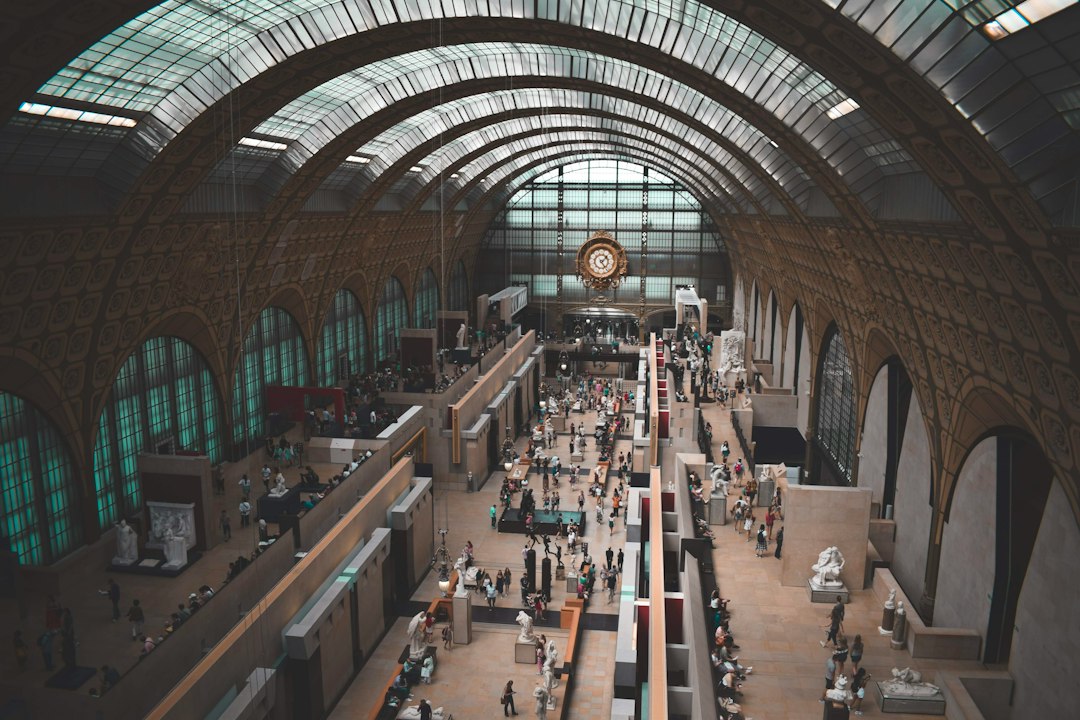

Entering the Musée d'Orsay means first crossing a train station. The Gare d'Orsay was inaugurated in 1900 on the occasion of the Exposition Universelle in Paris, designed by architect Victor Laloux in Beaux-Arts style. Its high and bright iron and glass vaults were not demolished when the station ceased operations in 1939: instead, after decades of abandonment and a long debate about their preservation, they were transformed into the museum we know today, officially inaugurated in 1986 under the presidency of François Mitterrand.
What makes this building immediately recognizable are the large circular wrought-iron clocks overlooking the Seine. From inside the museum, these clocks become transparent windows through which one can see Paris: looking at the city through the still hands of a nineteenth-century clock is one of the most unique visual experiences a European museum can offer. It is not a set built for tourists: it was the original function of the building, simply surviving its conversion.
The Impressionist Collection: What to See on the First Floor
The heart of the museum is located on the fifth floor, where the works of the Impressionists and Post-Impressionists are displayed. Here you can find masterpieces by Claude Monet, including some of his famous series of water lilies and landscapes of Normandy, alongside the dancers of Edgar Degas, the scenes of Parisian life by Pierre-Auguste Renoir, and some of the most well-known paintings by Vincent van Gogh, such as La chambre à Arles and his self-portrait with a green background from 1889.
The concentration of works in this space is such that it requires a selective and mindful visit. It is not possible to see everything with the same attention in a single day. Many visitors choose to dedicate the first pass to the Impressionist rooms and return later to the galleries on the ground floor, where sculptures and academic painting from the second half of the nineteenth century are located, often overlooked but equally relevant for understanding the context in which the Impressionist revolution was born.
The academic painting and the comparison with the avant-garde
One of the peculiarities of the Musée d'Orsay compared to other major museums is its ability to show the esthetic conflict of the nineteenth century directly. The large academic canvases — mythological subjects, historical compositions, idealized nudes — were exactly what the Impressionist painters were rebelling against. Seeing both traditions in the same building allows one to understand why Impressionism was so controversial at the time of its emergence.
On the ground floor, there are also sculptures by Auguste Rodin and his contemporaries, as well as a section dedicated to the decorative arts of the Art Nouveau period. The salle des fêtes, the former ballroom of the hotel that occupied part of the original building, is an architectural space worth visiting regardless of the works displayed inside.
Practical tips for organizing your visit
The museum is open every day except Monday, with continuous hours until 9:45 PM on Thursdays, a day when evening attendance is generally lower compared to the central hours of the day. Arriving after 5:00 PM on extended opening days is an effective strategy to avoid longer lines and experience the galleries with greater tranquility. The full ticket costs approximately 16 euros, but it is subject to seasonal variations and is free for visitors under 18 years old and for European residents under 26.
The museum is easily accessible by subway: the Solférino stop on line 12 is the closest to the main entrance on Rue de la Légion d'Honneur. Alternatively, the RER C stops directly at the Musée d'Orsay station. Booking tickets online in advance is strongly recommended during the summer months and during temporary exhibitions, which the museum regularly organizes on specific artists or periods. Allow at least three hours for a selective visit of the permanent collections is a realistic starting point.
The overall experience: architecture and art together
What distinguishes the Musée d'Orsay from a simple gallery is the constant relationship between content and container. The central nave of the former station, about 138 meters long, can be traversed like a corridor of sculptures, with the original stained glass windows filtering natural light. The architecture is not a neutral backdrop: it actively participates in the experience of the visit.
Climbing up to the clocks, overlooking the Seine with Paris in the background, and then returning to the rooms where Van Gogh painted in the midst of his crisis in Arles: this is the kind of juxtaposition that the museum makes possible effortlessly, simply because of how it is built and what it preserves.


