
🎄 Win a month in Italy for two — €10,000 · The Secret Italy Prize GO →
People's Square — Faenza
← Back
Fountains, Squares and Bridges 📍 Faenza, Italy 261 views

People's Square

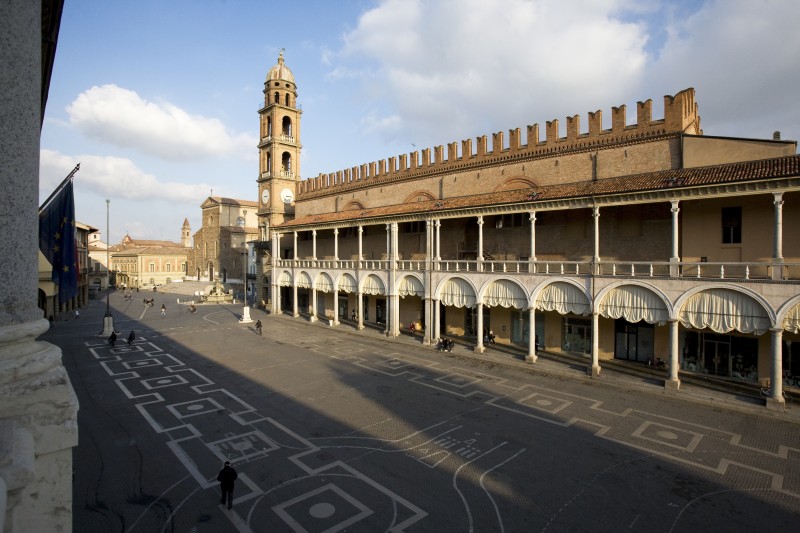
The square is obviously of very ancient origin but it began to take on the physiognomy that still characterizes it in the 15th century, with the construction of the loggia of the Manfredi palace, a construction that began precisely after the transformation into a seigniory of the...

Photo · Lucia C.

People's Square — Faenza, Italy.

Location
Faenza
Type
Fountains, Squares and Bridges
Opening hours
Weather now
↗ Directions

About People's Square

People's Square - Faenza | Secret World Trip Planner

The square is obviously of very ancient origin but it began to take on the physiognomy that still characterizes it in the 15th century, with the construction of the loggia of the Manfredi palace, a construction that began precisely after the transformation into a seigniory of the old city government and with the relocation of the Manfredi themselves to the municipal palace. On that occasion the palace was renovated and enriched on the upper floor with mullioned windows with white Istrian stone (only one remains) and by a large, two-story, seven-arched loggia. This was the first core of the loggia, later enlarged in the seventeenth century with the intention of unifying the entire side of the square, giving it a very distinctive architectural definition. The entire loggia was then rebuilt in neoclassical forms, similar to the original ones, in 1859 by municipal engineer Ignazio Bosi. On the other side stands the Palazzo del Podestà, to which a two-story loggia was added, at the expense of shopkeepers with stores in the square, in 1760. The initial plan, which was from the year before, called for a single story, but the Council of Elders wanted it two stories for symmetry with the loggia in front, that is, of the town hall. It was at this time that the idea of transforming a still undefined urban space into a regular square, architecturally punctuated by mirrored loggias in the manner of stage wings, according to a typically 18th-century concept, was realized. The side of the Palazzo del Podestà had to be given a hand in 1872-75, due to manifest problems of statics, and the work was entrusted to the talented municipal architect-engineer Achille Ubaldini, who used classical forms in imitation of those of the municipal palace, renovated some fifteen years earlier by Bosi. Ubaldini, who generally eschewed neoclassical canons in favor of following rather an eclectic culture, in this case sought to harmonize the new loggia with the existing one, adjusting one to the other so as not to introduce contradictory elements into the most "delicate" and most meaning-laden space in the entire city.

✦ Secret World · suggested day

A perfect day in Faenza

Start with People's Square, then continue with nearby places selected by Secret World.

  1. 01
    Morning
    People's Square
    📍 Faenza
    Start here
  2. 02
    Afternoon
    📍 0.2 km away
  3. 03
    Evening
    📍 0.4 km away

Collect this place

Turn places you discover into stamps in your Secret Passport.

Open Secret Passport →

Keep exploring · Faenza

Frequently Asked Questions

The square began taking on its distinctive character in the 15th century with the construction of the Manfredi palace loggia, but it wasn't fully realized as a formally designed urban space until the 18th century. The transformation was completed through the addition of the Palazzo del Podestà loggia in 1760, which created the symmetrical, stage-like architectural definition the square is known for today.
The square is characterized by two mirrored loggias facing each other: the seven-arched loggia of the Manfredi palace (town hall) featuring original white Istrian stone mullioned windows, and the two-story loggia of the Palazzo del Podestà built in 1760. Both loggias underwent neoclassical restoration in the 19th century, with the town hall loggia rebuilt in 1859 by Ignazio Bosi and the Podestà loggia restored in 1872-75 by architect Achille Ubaldini.
The original 1759 plan called for a single-story loggia, but the Council of Elders insisted on two stories to create symmetry with the town hall's loggia across the square. This decision was crucial in realizing the 18th-century urban design concept of creating a formal, architecturally balanced public space with mirrored structures resembling theatrical stage wings.
Municipal engineer Ignazio Bosi rebuilt the town hall loggia in neoclassical style in 1859, while the talented architect-engineer Achille Ubaldini restored the Palazzo del Podestà loggia from 1872-75. Ubaldini successfully harmonized his new construction with the existing loggia using classical forms, ensuring architectural continuity across the square despite different time periods.
The square's origins date to ancient times, but it became historically significant in the 15th century when the Manfredi family relocated to the municipal palace and transformed the city government into a seigniory. The square evolved into a masterpiece of 18th-century urban planning, exemplifying the period's architectural ideals through its symmetrical loggias and carefully proportioned public space design.

Experiences nearby · Faenza

Powered by Viator

See more on Viator.com

Secret World @php $__al = $lang ?? app()->getLocale(); @endphp @if($__al === 'ko')숨겨진 명소, 진짜 이야기 — 여행을 계획하세요 @elseif($__al === 'ja')隠れた名所とリアルな物語 — 旅を計画しよう @elseHidden places, real stories — plan your trip@endif
@if($__al === 'ko')무료 앱 시작하기@elseif($__al === 'ja')無料アプリを入手@else Get the app @endif
