
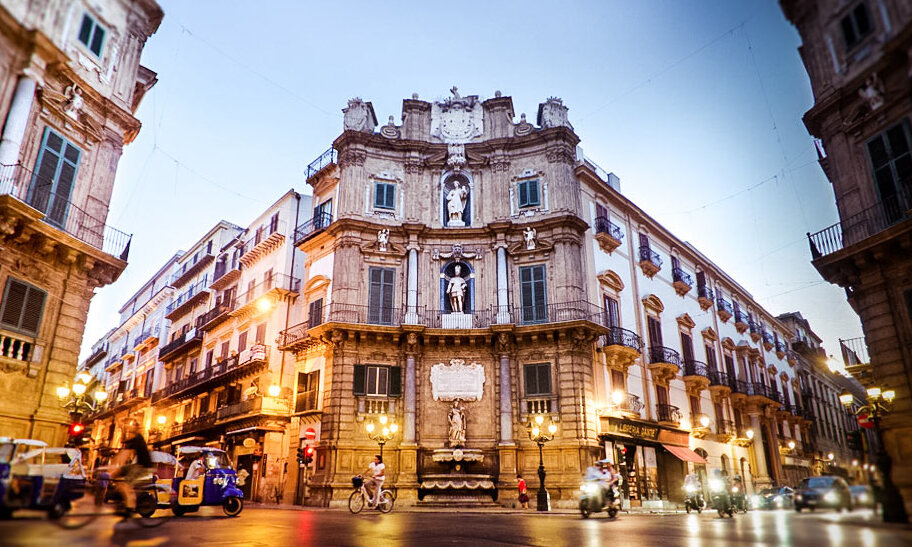

Nestled in the heart of Palermo, Piazza Vigliena, more commonly known as the Quattro Canti or Ottagono del Sole, serves as a vibrant testament to the city’s rich history and Baroque splendor. This octagonal square, defined by its harmonious architectural layout, is not merely a meeting point; it embodies centuries of urban evolution and cultural intertwinement.
The origins of Quattro Canti date back to the early 17th century when it was constructed as part of the ambitious urban planning project commissioned by the Spanish viceroy, D. Juan de la Cerda, in 1608. Designed by the architect Giovanni Battista Basile, it marked a significant departure from medieval urban design, reflecting the Renaissance ideals of symmetry and order. The square was strategically positioned at the intersection of Via Maqueda and Via Vittorio Emanuele, acting as a gateway between the city’s four major districts.
Throughout its history, the square has witnessed pivotal moments, from political gatherings to social celebrations, making it a focal point of Palermo’s civic life. During the Spanish rule, it became a symbolic representation of power, both secular and religious, housing statues of the four patronesses of Palermo — Cristina, Ninfa, Olivia, and Agata — who were honored before the emergence of Santa Rosalia as the city’s principal saint in 1624.
Artistically, Piazza Vigliena showcases the quintessential Sicilian Baroque style. The four facades of the square are adorned with intricate sculptures and decorative elements that celebrate the seasons and the Spanish kings of Sicily. The statues, crafted by the talented Giovanni Battista Mazzola, depict Winter, Spring, Summer, and Autumn, along with the monarchs who ruled during their respective seasons. The fountains, framed by the ornate architecture, create a dynamic interplay of water and light, especially stunning at sunset when the golden hues of the buildings reflect in the flowing water.
As you wander through the square, you’ll also notice the vibrant local culture that envelops it. Piazza Vigliena is a hub for locals and tourists alike. Street vendors offer a taste of Palermo’s culinary delights, such as arancini (rice balls filled with meat or cheese), pane con la milza (spleen sandwich), and cannoli. The lively atmosphere is punctuated by the sounds of laughter and chatter, embodying the city's warm hospitality.
Festivals frequently infuse the piazza with a sense of celebration. The Festa di Santa Rosalia, held every July, is a particularly noteworthy event that draws crowds from across the island. This festival honors the patroness of Palermo, featuring a grand procession that weaves through the streets, culminating in the square where locals gather to celebrate with music, food, and fireworks.
However, beyond the obvious beauty and vibrancy of Quattro Canti, there are lesser-known curiosities that enrich its narrative. For instance, the square is often referred to as the “Ottagono del Sole” because of its unique shape and the way the sunlight dances across the piazza, creating intricate patterns on the ground. Additionally, an intriguing historical tidbit reveals that the square served as a gathering point for the mafioso during the 20th century, making it a silent witness to the darker chapters of Palermo’s history.
For visitors looking to explore Piazza Vigliena, the best time is during the late afternoon when the square is bathed in warm sunlight, perfect for photography and leisurely strolls. Pair your visit with a detour to Piazza Pretoria, just a stone's throw away, where the majestic Fountain of Pretoria and the Church of San Giuseppe dei Teatini await, showcasing more of Palermo’s Baroque grandeur.
When planning your visit, consider indulging in a local café where you can sip on granita or a rich espresso, soaking in the vibrant atmosphere. Don’t forget to look up — the intricate details of the buildings often go unnoticed by hurried tourists.
In conclusion, Piazza Vigliena is a microcosm of Palermo’s rich tapestry of history, art, and culture. This octagonal square, with its harmonious blend of architectural beauty and local life, invites you to pause and reflect on the stories it holds. For a personalized journey through Palermo, consider using the Secret World app to craft your unique itinerary.


