
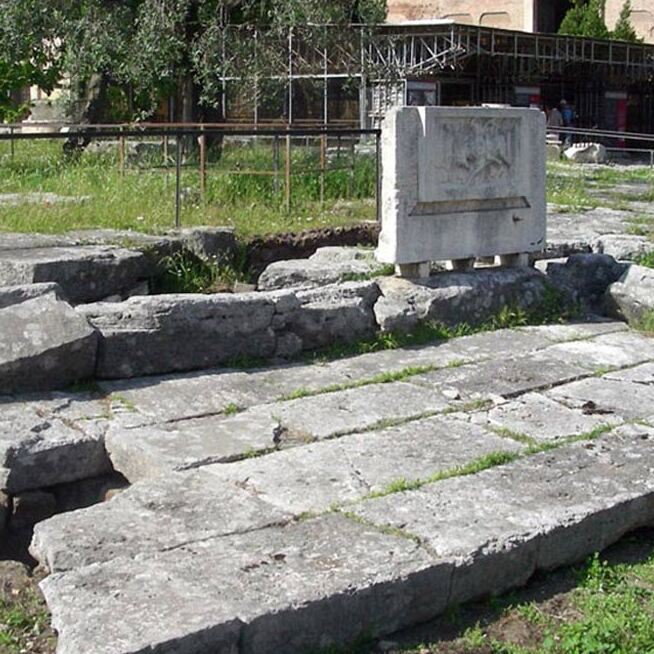

In the heart of the Roman Forum, surrounded by the whispers of ancient history, lies a site that blends myth and reality: the Lacus Curtius. This unassuming stone well, located near the Curia Julia, has sparked the imagination of Romans and visitors alike for centuries. Believed by some to be an entrance to the underworld, the Lacus Curtius is a testament to Rome’s rich tapestry of legend and history.
The origins of the Lacus Curtius are steeped in mystery. According to Roman legend, the site was named after the young hero Marcus Curtius, who, during a tumultuous time in ancient Rome, sacrificed himself to close a gaping chasm that appeared in the Forum. The story tells of an oracle’s decree that the city could only be saved if Rome's greatest strength was offered to the gods. Marcus Curtius, clad in full armor, declared that the valor and courage of its citizens were Rome's greatest assets and leaped into the abyss. Historical accounts, however, suggest that this might have been merely a marshy patch that was drained and paved over. Regardless of its true origin, the Lacus Curtius serves as a poignant symbol of Rome’s intertwining of myth and reality.
Architecturally, the Lacus Curtius is modest yet evocative. It comprises a simple paved area with a stone well at its center, surrounded by low barriers. The site’s unadorned design contrasts starkly with the grandeur of the nearby Temple of Saturn and the Arch of Septimius Severus, yet its significance is no less profound. While it lacks the elaborate sculptures and intricate carvings that adorn many Roman structures, its simplicity invites contemplation and reflection on the stories that have shaped this ancient city.
The cultural significance of the Lacus Curtius is woven into the fabric of Roman traditions. While no specific festivals are dedicated to this site, its legend is often recounted during celebrations of Roman heritage, such as Natale di Roma, the anniversary of Rome’s founding on April 21st. On such occasions, locals and historians gather in the Forum to honor the city’s storied past, recounting tales like that of Marcus Curtius, which underscore Rome’s enduring spirit.
No visit to Rome is complete without indulging in its legendary gastronomy. While the Lacus Curtius itself isn’t associated with specific culinary traditions, the nearby neighborhoods offer a bounty of Roman flavors. From Cacio e Pepe, a simple yet sublime pasta dish, to Carciofi alla Romana, artichokes prepared Roman-style, the area around the Forum offers a feast for the senses. For a quick refreshment, try a glass of Frascati, a white wine from the nearby hills, perfect for sipping as you ponder the ancient tales of the Forum.
Amidst the throngs of tourists exploring the Roman Forum, the Lacus Curtius is often overlooked, yet it holds secrets that many miss. One lesser-known curiosity is that during certain times of the year, particularly after heavy rains, water pools inside the well, lending credence to its ancient depiction as a watery chasm. Additionally, fragments of inscriptions found near the site allude to its significance in various eras of Roman history, providing a tangible connection to the past.
For those planning a visit, the best time to explore the Roman Forum and the Lacus Curtius is in the early morning or late afternoon, when the crowds thin and the light casts a golden glow over the ancient stones. Comfortable shoes are a must, as the terrain is uneven and the area expansive. As you wander the site, take a moment to sit by the well and imagine the world beneath, as ancient Romans once did. Look for the subtle details—like the weathered stones that bear the marks of centuries—and let your mind wander through time.
In the Lacus Curtius, history and myth converge, allowing visitors to glimpse the heart of ancient Rome. It stands as a quiet reminder of the city’s legendary past, inviting us all to step back into a world where stories were alive, and the line between the earthly and the divine was blurred.


