



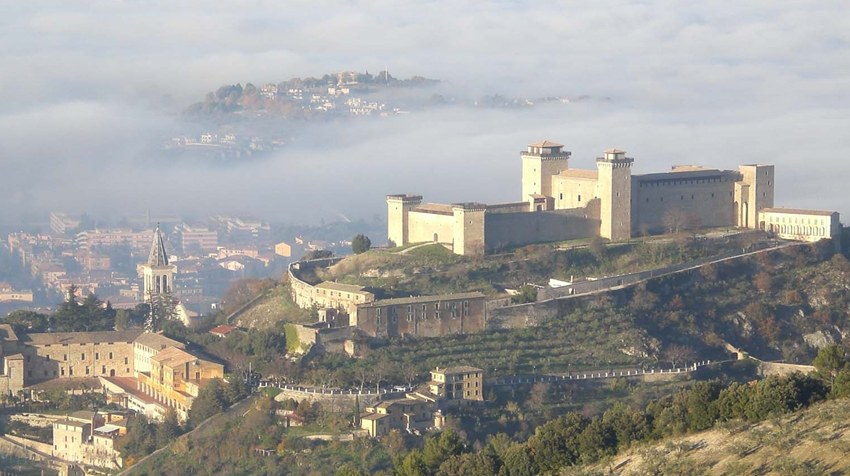
The origin of the city's name is traced by some to the Etruscan word "spur," meaning city. But most attribute it to the Greek "spao lithos," split stone. In fact, St. Elias Hill appears precisely as a part of Monteluco, split.
There are traces showing that Spoleto was inhabited since prehistoric times, at least since the seventh century B.C., by the people deglli Umbrians. Tombs dating back to the Iron Age have also been found.
Cyclopean walls, dating from the 5th-4th centuries B.C., suggest a fortified city, erected in a strategic position where the Umbrian valley closes.
"Spoletium" became a Roman colony in 241 B.C., and remained loyal to Rome over time. During the Punic Wars, it defended the capital by repelling Hannibal after his victory at Trasimeno (217 B.C.).
After the fall of the Western Roman Empire (476 A.D.) Spoletium embarked on the most splendid period of its history, which lasted a full 600 years..
In the early 500s the city was restored and the marshes in the valley at its foot were reclaimed.
In 545 it was conquered by Totila, king of the Ostrogoths, but nine years later it was recaptured restored by Narses, who also provided for the restoration of part of the walls.
In 571, with the first Duke, Faroaldo, Spoleto became the capital of the Lombard Duchy of Spoleto, forming Langobardia minor along with the Duchy of Benevento. Any map of the early and late Middle Ages shows the name of Spoleto, although the boundaries of the Duchy, over that long period, changed, extended and retracted When the Lombards fell (774), the Duchy passed to the Franks. When the Carolingian Empire was dismembered, the Dukes of Spoleto, Guido III and his son Lambert, became Kings of Italy and emperors of the Holy Roman Empire.
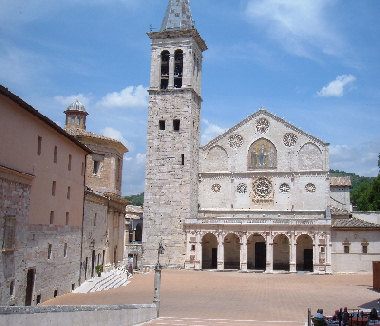
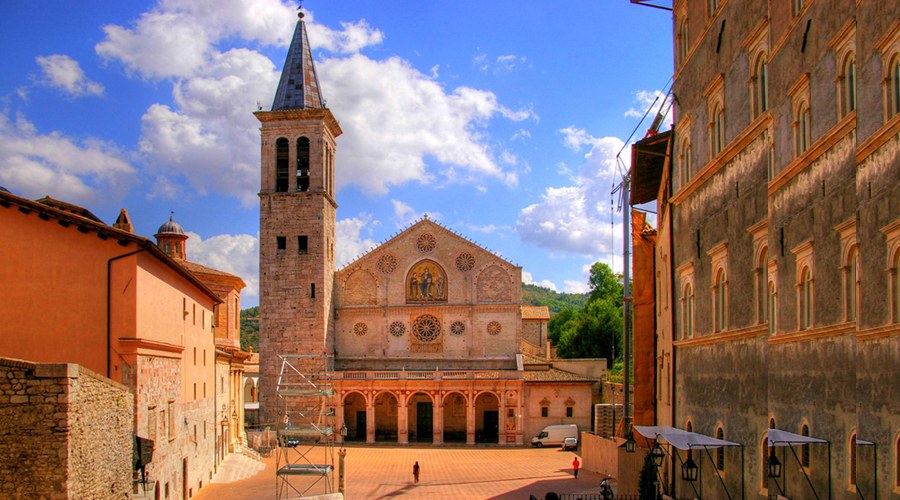
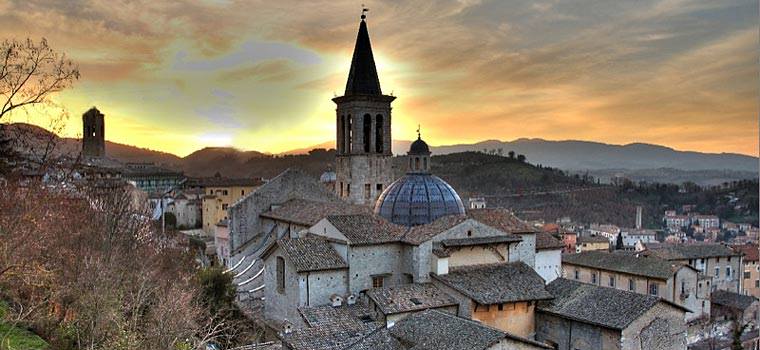
In 1155 Spoleto, " the city of a hundred towers," was attacked by Frederick Barbarossa, who renounced the plunder at the price of a ransom. The Spoletini paid it by going as a delegation to the present Piazza d'Armi, site of the enemy camp. But,according to legend, the coin was counterfeit, so that Barbarossa attacked and destroyed the city. Later the delegations reached an agreement and Barbarossa, as a sign of peace, gave the city the icon of Our Lady, which is still kept in the Cathedral.
Spoleto was the scene of struggles between Guelphs and Ghibellines, not unlike many other important cities in late medieval times. Pope Innocent III, in 1198, declared it annexed to the state of the Church, so that this year is conventionally taken as that of the end of the Duchy.
When the Avignonese Captivity (1309 / 1377) disintegrated the state, Cardinal Egidio Albornoz, who understood the strategic importance of the site, was sent to Italy by Pope Innocent VI. So from Forli, where he was to fight the Ordelaffi, in 1362 he ordered by letter the construction of the most imposing castle in the necklace of Albornoz fortresses. The architect Matteo di Giovannello da Gubbio, known as Gattapone, completed it in just five years.
In the Renaissance Spoleto alternated periods of vigor with periods of regression. I was nevertheless an important seat of the Papal States: no less than two popes, Urban VIII and Pius IX, had been archbishops of Spoleto. During the French occupation, Spoleto was the capital of the Clitunno Department and then of the Trasimeno Department. From the Restoration (1814) it was the seat of a Papal Delegation.
On September 17, 1860, three days before the breach of Porta Pia, Piedmontese General Filippo Brignone entered Spoleto, conquering the city to the nascent Kingdom of Italy. The new Italian state, however, favored Perugia as the capital of the province that also incorporated the territory of Spoleto.
