
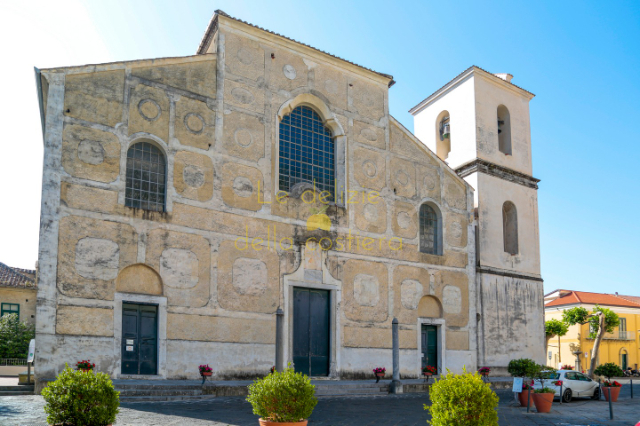

The Scalese community has for many centuries venerated in the Crypt of the Cathedral of San Lorenzo the "Crucifix," to which the prayers and supplications of all the faithful of the Amalfi Coast are often addressed.
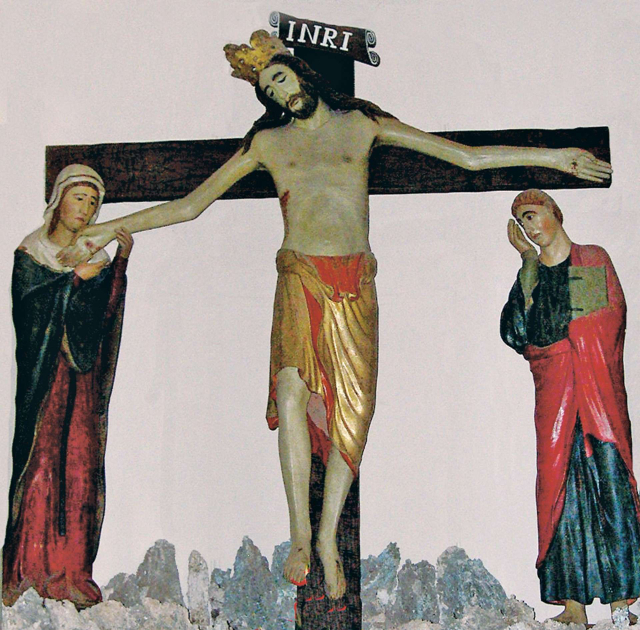
The 13th-century polychrome wooden complex of the Umbrian-Tuscan school and depicting the Deposition of Jesus from the Cross consists of Christ the Redeemer in the center, the Virgin Mary on his right and John the Evangelist on his left; originally three other figures could be seen: Joseph of Arimathea and Nicodemus on two ladders intent on lowering Christ's body and Mary Magdalene kneeling to receive him.
This work was probably commissioned and sculpted for the Cistercian monastery of St. Helena, located on the border between Scala and Amalfi, and in 1586 it was transferred to the Cathedral of San Lorenzo where it was initially placed in the right apse of the upper church, and in 1705 it was then transferred to the Crypt and placed above the high altar, where it still stands today.
A skilful restoration carried out in the 1990s by the Central Institute for Restoration in Rome established that the statue of Christ consists of three pieces: the body and the two arms; it was carved from poplar wood emptied of its pith to allow for an optimal state of preservation; the original crown, carved directly into the wooden body and formed of carved wood and glass stones, was returned to the work; originally on the head was a metal crown donated as an ex voto.
The people of Scala have been handing down many episodes related to graces and miracles performed by the Holy Crucifix of Scala for centuries and decades, and the Cathedral preserves some paintings as ex voto. One depicts a ship in a storm and in the sky shrouded in divine light the Crucifix; at the base of it an inscription reads, "the night of November 15, 1880 in the sea of the Indies - Antonio Esposito. Another depicts two people praying for their loved ones lost in the war in front of the Crucifix and underneath the inscription, "1915-1918."
There are numerous stories handed down by the faithful of Scalese concerning the wonders performed by the miraculous Crucifix, some of which are very old.
It is said, in fact, that in the early 1600s Scala was hit by a severe famine: food and supplies ran out and people began to die of starvation; desperate people gathered around the altar of the Crucifix to pray and ask for Grace, but in those very days a ship full of provisions arrived in the Port of Amalfi, which a man destined to the Lord of Scala by giving the captain of the vessel his ring as a guarantee.
The sailors carried the goods on their shoulders to Scala and unloaded them in the square; the people who rushed in literally assaulted the cargo of provisions and the captain who wanted to be paid for the work he had done appealed to the regent of Scala but he denied the order of those goods, so did the other nobles of the country. The ship's captain then began to tell about the man from the port by showing everyone the ring, and many immediately noticed the similarity of the jewel to that of the Crucifix. They all rushed to the church before the imposing statue of their Christ, and upon arriving there, even the captain, upon seeing the Crucifix, threw himself to the ground on his knees and in tears revealed that Christ was the man who had given him the ring. From that day on, everyone called the Crucifix "the Lord of Scala."
It is passed down, then, the story of a period of great drought in which the people of Scala, for fear of losing their harvest and with it their only source of livelihood, turned with prayers and supplications to the Crucifix.
It was carried in procession from the Cathedral to Minuta and during the procession the first miraculous signs were seen given by a deep perspiration of the statue; the prayers of the faithful became more intense and fervent as if waiting for the miracle that did not take long to arrive when they reached Minuta: before entering the church it began to rain. The people climbed once again rejoiced and thanked the Crucified and Risen Christ who had once again answered their prayers.
Processions were also used to obtain graces from the Blessed Crucifix during the two world wars, in 1915 and 1941; the second one saw such intense participation by people from all the towns on the Coast that when the Crucifix arrived in Ravello, the final part of the procession was still moving from Via Vescovado in Scala.
It is still said that citizens of Amalfi, claiming ownership of the statue of the Most Holy Crucifix, came from Amalfi and stole it, carrying it on their shoulders along the road that connects Pontone with Amalfi; when they reached the boundary between Scala and Amalfi, the Crucifix became so heavy that the men had to abandon it there and flee. The next day the statue was found by some of the inhabitants of Pontone who were descending toward Amalfi and who ran to warn the population.
The statue was solemnly carried back in procession to Scala Cathedral; even today along the path that connects Scala with Amalfi it is possible to see a stone that marks the boundary but also the place where the statue of the Holy Crucifix was found.
From the website "Il Vescovado"


