
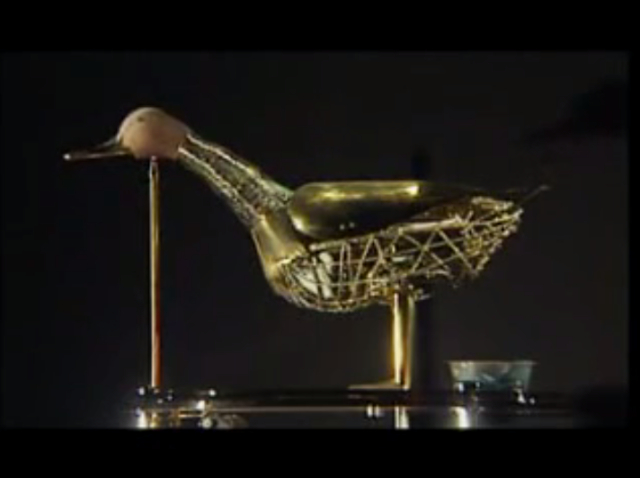

In 1889, in the smoldering ruins of a museum in Krakow, Poland, only a pair of heat-deformed wings were discovered, all that remained of the most famous of all automata: the Digestrice Duck. Built in 1739 by Grenoble artist Jacques de Vaucanson, this creation soon became his most famous work, thanks to its realistic movements, craftsmanship, and incredible ability to expel ingested food.The Digestrice Duck represented the pinnacle of Enlightenment automaton authors' efforts, both for entertainment and for scientific and philosophical reasons. Vaucanson also produced other striking works, such as two life-size humanoid musicians. His creations, including the duck, were made in Paris after several earlier attempts with mechanical devices and automata.The duck was placed on a large base that housed the mechanics, and its construction was life-size, consisting of hundreds of parts covered with perforated gold-plated copper to allow observation of its inner workings. When activated, the duck moved like a real bird: it moved its beak through the water, emitted a caw, and realigned itself to its position. But what made the duck famous was its ability to swallow and then, after "digestion," expel the offered morsels.Vaucanson's duck quickly became a big attraction, so much so that Voltaire himself sarcastically wrote, "Without Vaucanson's duck, you would have nothing to remind you of the glory of France." But after a few years, Vaucanson tired of his creations and sent them on a grand tour with keepers. He then went on to a new assignment, designing automatic looms for the French silk industry, a colorful chapter in his life that also led him to have to flee disguised as a monk because of a silk workers' revolt.Over the years, the automatons changed owners and ended up in the hands of eccentric collectors. In 1805, Johann Goethe saw the duck in the private collection of Gottfried Christoph Beireis, noting that the automata were paralyzed and lifeless. Repaired for a final appearance at the Exposition Universelle in Paris in 1844, the duck continued to arouse fascination, even as manipulations in the automaton's digestive system were discovered, revealing that the feces were actually stored in a hidden compartment.After this final exhibit, the duck went into oblivion until it was rediscovered among the artifacts in a museum in Krakow. Unfortunately, a fire destroyed the building, and the damaged wings were taken as evidence of its demise. However, the Vaucanson duck continued to live on in popular culture, inspiring literary, artistic and cinematic works.Today, a beautiful replica of the duck is on display at the Museum of Automata in Grenoble, created in 1998 by Frédéric Vidoni, a skilled maker and restorer of automata. The museum houses a small collection of music boxes and automata, but Vaucanson's duck remains its main attraction.In conclusion, Vaucanson's Digestrice Duck is one of the most famous and fascinating creations in the history of automata. Its ability to reproduce the movements of a duck and its "digestion" mechanism made it a symbol of the technological innovation of its time. Despite the difficulties and unfortunate vicissitudes involving its various versions over the years, Vaucanson's duck continues to evoke wonder and curiosity in the modern public, testifying to the ingenuity and creativity of the French artist and engineer.


