

In the vibrant heart of Dublin, precisely at the intersection of Amiens Street, Beresford Place, and Memorial Road, stands a monumental sculpture that conveys a strong message of justice and freedom: the Universal Links on Human Rights. This work, commissioned by Amnesty International in 1995, is a sphere made of interlinked chains and bars, with a diameter of 260 cm, at the center of which burns an eternal flame fueled by natural gas. The sculpture is not just a work of art, but a memorial dedicated to prisoners of conscience, symbolizing the fight against oppression and the violation of human rights.
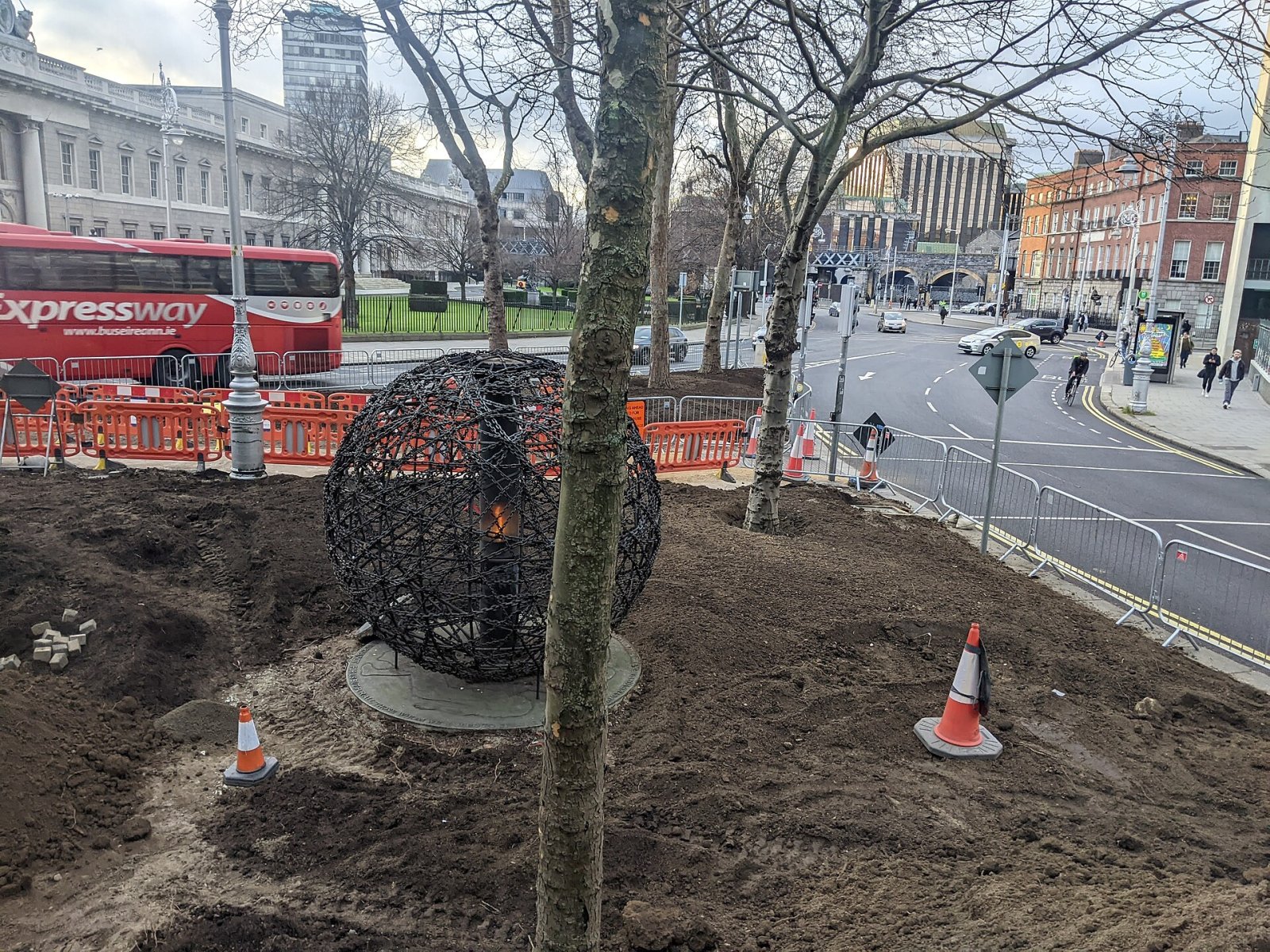
Created by artist Tony O'Malley, the Universal Links on Human Rights is a powerful and poignant visual call that invites passersby to reflect on the state of human rights in the world. Its strategic location, near iconic places like Busáras and The Customs House, makes it easily accessible and a landmark for visitors to the Irish capital.
Historical and Cultural Context
Dublin, a city rich in history and culture, has always played a significant role in the struggle for civil and human rights, not only in Ireland but globally. The Universal Links on Human Rights is emblematic of this commitment, representing an artistic response to the injustices that afflict people around the world. The sculpture was conceived at a time when awareness of human rights was growing, and Amnesty International was gaining visibility as a human rights advocacy organization.
This work is not only a tribute to prisoners of conscience but also an invitation to reflection and action. The choice to use interlinked chains and bars as the main material symbolizes the various forms of oppression and the need to unite forces to combat them. In this context, the Universal Links on Human Rights becomes a beacon of hope and resistance.


