
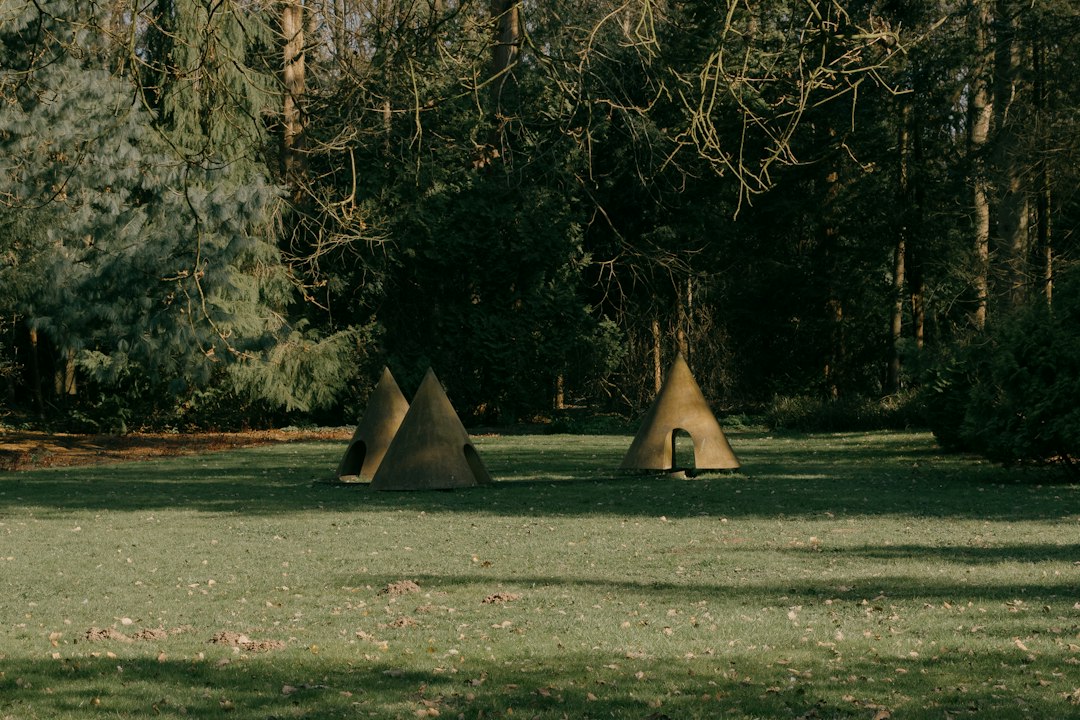

Large metal shapes and stone volumes emerge from the green meadows along the banks of the Rhine, in Cologne, without entrance signs, without turnstiles, without ticket offices. The Skulpturenpark Köln — this is the official name in German — is an outdoor contemporary art park that occupies a strip of land along the river, in the Riehl district, on the left bank of the Rhine. Those who arrive for the first time often do not realize that they have entered an exhibition space: the sculptures are simply there, in the landscape, as if they have always existed.
Founded in 1997, the park was created with the aim of making contemporary art accessible to everyone, literally: admission is free and the park has no closing hours. The exhibited works change over time, following a rotation program that involves international artists. It is not a permanent collection in the traditional sense, but a continuous cycle of large-scale installations that interact with the river landscape and with the visitors passing by — joggers, families, cyclists — often without knowing they are in the midst of an open-air museum.
The sculptures and the landscape: a dialogue without mediators
What immediately strikes is the direct relationship between the works and the natural space. There is no imposed safety distance, there are no ropes. The sculptures — which can exceed three or four meters in height — are located among the meadows, near the trees, with the Rhine in the background. This creates a radically different experience of art from that of a museum: one walks around the works, touches them, sits next to them, and sees them change appearance with the morning or sunset light.
The installations hosted over the years have included works by European and international artists, with sculptures in corten steel, bronze, concrete, and composite materials. The variety of formal languages is wide: from abstract geometries to organic shapes, from shiny surfaces that reflect the sky to rough surfaces that seem to grow from the earth. Each work is accompanied by a small informational plaque indicating the name of the artist and the title of the work, the only concession to museum pedagogy in an otherwise completely free context.
Why it is almost unknown to international tourism
Cologne is a city that international tourists visit mainly for the Gothic Cathedral — the Kölner Dom, with its 157 meters in height — and for the historic center. The Skulpturenpark is located a few kilometers from the tourist heart of the city, reachable by bicycle along the Rhine bike path or by public transport. This decentralized location, combined with the absence of any form of aggressive marketing, makes it almost invisible to standard tourist circuits.
Yet it is one of the most visited exhibition spaces by the local artistic community and the residents of the neighborhood. On weekends, especially in spring and summer, the lawns fill up with people having picnics, reading, walking dogs — and in the midst of all this, the sculptures continue to do their silent work. It is a form of integration between art and everyday life that few other places achieve so naturally.
Practical information for those who want to visit it
The park is located in the Riehl district, in the northern part of Cologne, along the left bank of the Rhine. The nearest stop can be reached by the light rail line (Stadtbahn) that connects the city center to the northern area. Alternatively, the bike path along the Rhine allows you to get there by bicycle from the center in about twenty or thirty minutes, with a pleasant ride along the river.
The best time to visit is early in the morning, when the slanting light enhances the surfaces of the sculptures and the lawns are still empty. Alternatively, late afternoon offers a warm light that completely transforms the appearance of the metal works. A complete visit takes about an hour, but it's easy to stay longer if the weather permits. Entry is completely free and no reservation is required. Bringing something to eat and drink is a good idea: the lawns invite you to stop, and the only bar nearby is a few minutes' walk away.
An experience that changes the way you view public art
Visiting the Skulpturenpark Köln means experiencing a different model of artistic enjoyment, where the work is not separate from life but immersed in it. The sculptures do not wait silently inside a climate-controlled room: they withstand the wind, the rain, the light that changes with the seasons. They slowly wear away, oxidize, change color. This process is part of the work itself.
For those traveling to Cologne with a genuine interest in contemporary art, this park offers something that no traditional museum can provide: direct, physical, and unmediated contact with works designed to exist outdoors. And all of this, without spending a euro.


