
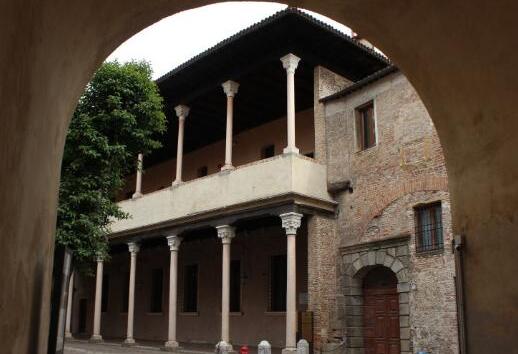

Behind the Liviano Palace and the Cathedral, in via dell'Accademia, we find the only part that has remained intact to symbolise the grandeur of the palace: the Loggia Carrarese, today the seat of the Accademia dei Ricovrati, now the Accademia Galileiana di Scienze, Lettere ed Arti, which was founded in 1599 by illustrious men of letters and personalities from the Veneto culture and aristocracy, including Galileo Galilei and Cesare Cremonini. The double loggia of the Academy and the adjacent rooms, which we can still admire today and whose construction was completed in 1343, were the residence of the Princes. The slender and elegant columns of rose-coloured marble from Verona, embellished by the use of wooden architraves, delimit on two sides a vast space, called "praetto", once used as a garden and bordering on the west side with the city walls. After the death of Ubertino (1345) the need was felt to build a place of prayer and recollection, not only for the family, but also for the many guests, especially prelates. The external Loggia was then closed and reduced to a Chapel, which Guariento frescoed between 1355 and 1360 with scenes from the Old Testament. Over the years, the "Ricovrati" of the Accademia Patavina, who had already had their seat in that building since 1780, decided to knock down a wall of the Chapel in order to enlarge the Sala delle Adunanze, thus destroying part of the admirable frescoes; they removed from the ceiling the panels with the famous Angels, now kept in the Civic Museum of Padua, enlarged the windows interrupting the frescoes and walled up part of the loggia, building a chimney inside. In 1917 the loggia was freed from the superstructure built by the academics and the portico with the columns was restored. In the Assembly Hall of the Academy, the western wall is still largely covered by the original frescoes arranged in two bands, each surmounted by a frieze in which appear some Gothic inscriptions, mostly illegible. Underneath the two bands there is a plinth with false marble panels on which rests a series of small arches decorated with floral motifs. In addition to the splendid frescoes, the decoration of the Sala delle Riunioni also includes a very precious map, dating back to 1784, by the cartographer Giovanni Valle, the first to use trigonometric calculations in the creation of maps, and the original hemicycle bench attributed to the famous Venetian architect Jappelli. In a ground room of the palace you can also see some fragments of heraldic decorations from different times, such as the "talking" sign of the chariot alternating with the crest of the Moor by Ubertino da Carrara. Further rooms and corridors can be visited, which still bear the remains of frescoes, decorations and historical representations.


