
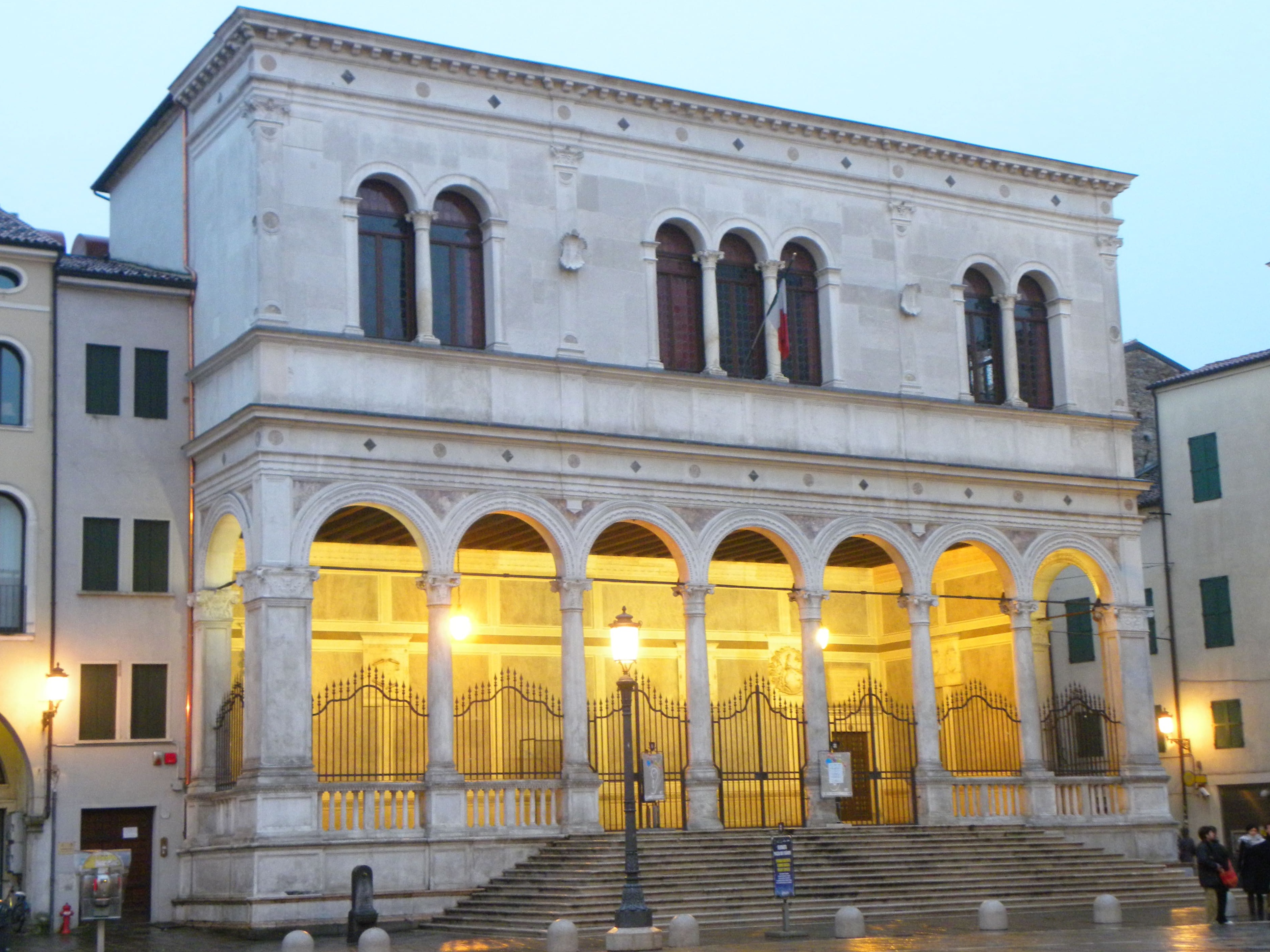

At the corner of the street leading from Piazza dei Signori to the Duomo, in the past the centre of confluence of the most important road system, the true heart of the city, stands the Loggia del Consiglio, because it was here that the city's Maggior Consiglio met after the fire in the Salone in 1420. The elegant Renaissance building with its Lombard imprint was designed by Annibale Maggi da Bassano, the last representative of a style that was still fifteenth-century in its rhythms and decorations, which had dominated in Padua at the end of the fifteenth century. The building is commonly called Gran Guardia because it was used as a military command post during the Austrian domination. The Loggia, for the harmony of its proportions and its sober elegance, is the most classical and accomplished representation of the new Renaissance, a true masterpiece of local architecture of the transitional period between the 15th and 16th centuries, characterised by the particular decorations of the pedestals and the use of polychrome marble of clear Lombard taste. In 1496 Maggi supervised the works, which in the following years proceeded slowly and laboriously, often interrupted by long pauses. Suspensions were due both to economic problems and to the war events of 1509, with the siege of Padua by Maximilian's troops during the tragic days of the War of Cambrai. The work then resumed in 1516 under the guidance of Biagio del Bigio from Ferrara and later in 1530 by Giovanni Maria Falconetto who, together with the work on the Clock Tower, intervened in the new renovation configuration of Piazza dei Signori. A wide flight of steps leads to the Loggia del Consiglio, which opens with seven full-centre arches on the façade and two on the sides, set on columns and angular pillars. In the loggia, with a beamed ceiling decorated with marble decorations and coats of arms, a door opens on the left at the back, leading to the upper room via a wide staircase interrupted by a landing. The great hall is decorated with a lacunar ceiling (decorated ceiling panel) by Giovanni Paolo da Venezia and Girolamo dal Santo, with a series of frescoes along the longitudinal walls, and with a canvas on the wall above the bench where the Maggior Consiglio sat. The frescoes of 1667, attributed to the Bolognese Pier Antonio Torri, represent legendary and historical episodes of Padua, including the foundation of the city by Antenore, the victory of the Paduans over the fleet of the Spartan king Cleonimo, and the Suicide of Trasea Peto. The canvas on the eastern wall, depicting Padua between Justice and Wisdom, is the work of an uncertain painter of the 18th century, perhaps Giulio Girello, a renowned author at the time for this kind of celebratory scenes of an official nature. It replaces the more famous canvas painted by Domenico Campagnola in 1537, now in the Civic Museum.


