
← Back

The Royal Palace of Carrara

Piazza Capitaniato, 35139 Padova PD, Italia ★★★★☆ 267 views
Simona Illy
Padova
🏆 AI Trip Planner 2026

Get the free app

Discover the best of Padova with Secret World — the AI trip planner with 1M+ destinations. Get personalized itineraries, hidden gems and local tips. Free on iOS & Android.

🧠 AI Itineraries 🎒 Trip Toolkit 🎮 KnowWhere Game 🎧 Audio Guides 📹 Videos
Download on the App Store Get it on Google Play
Scan to download Scan to download

About The Royal Palace of Carrara

The Royal Palace of Carrara - Padova | Secret World Trip Planner

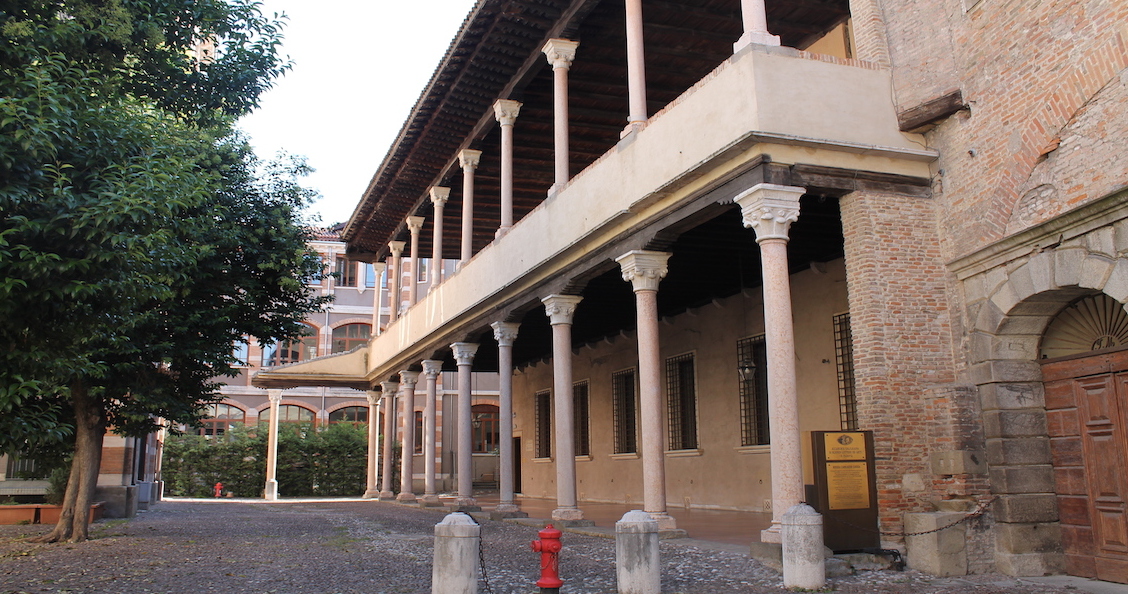
With the building of the palace as a residence, commissioned by Ubertino in 1338, the Carraresi family affirmed its power in Padua. The area of land chosen for the construction of the palace, updated to today's toponymy, finds its boundaries in the area bordering the north side of Piazza del Duomo, via Monte di Pietà, Piazza dei Signori, via Dante up to the height of the pavement of S.Nicolò and continuing westwards with the street leading to the Teatro Verdi; bending then southwards, with via Dondi dell'Orologio and via Accademia. The ancient palace of the Lords of Padua was an authentic "island" in the heart of the city enclosed all around by a wall with a long walkway. Ubertino had a sort of hanging corridor built, called traghetto, which connected the palace with the first city walls, as far as the Castle, today the Astronomical Observatory or Torlonga or Specola, which was useful in case of danger and escape and could also be covered on horseback. The ferryboat, declared a "cumbersome and dilapidated ruin", was then completely destroyed in 1777; only a ruin of a pillar and an arch set on it recall the old hanging viaduct. In the palace there were a Palace of the West (1343), the residence of the princes and a Palace of the East, first intended for the Curia and then reserved for women, which were connected by a central body with a large courtyard surrounded by a portico with columns. Unfortunately, towards the end of 1800 the beautiful courtyard was demolished, together with most of Ubertino's palace. The upper loggias of the courtyard of honour led to the two main reception rooms of the Da Carrara family, one opposite the other: the Sala Tebana, the older and smaller, and the sixteenth-century Sala degli Eroi or dei Giganti, now annexed to Palazzo Liviano, the building named after Tito Livio, which was designed by Giò Ponti between 1937 and 1939 as the seat of the Faculty of Arts of the University and which also houses the Museum of Archaeological Sciences and Art.

🗺 AI Trip Planner

Plan your visit to Padova

Suggested itinerary near The Royal Palace of Carrara

MAJ+
500.000+ travelers worldwide
  1. 🌅
    Morning
    The Royal Palace of Carrara
    📍 Padova
  2. ☀️
    Afternoon
    The Hall of the Giants at the Liviano
    📍 0 km · Padova
  3. 🌆
    Evening
    Loggia Carrarese
    📍 0.1 km · Padova

Buy Unique Travel Experiences

Powered by Viator

See more on Viator.com

Explore nearby · Padova

Frequently Asked Questions

The Royal Palace of Carrara was commissioned by Ubertino in 1338 as a residence to affirm the Carraresi family's power in Padua. This magnificent palace served as the seat of the Lords of Padua and was an architectural marvel of its time.
The traghetto was a hanging corridor built by Ubertino that connected the palace to the city walls and Castle (now the Astronomical Observatory), serving as both an escape route and a passageway that could be traveled on horseback during times of danger. Though completely destroyed in 1777, only a pillar and arch remain today as remnants of this unique viaduct.
The two main reception rooms of the Da Carrara family are the Sala Tebana, the older and smaller room, and the sixteenth-century Sala degli Eroi (Hall of Heroes), which is now annexed to Palazzo Liviano. These rooms were accessed via upper loggias from the palace's central courtyard of honour.
Unfortunately, most of Ubertino's original palace was demolished towards the end of the 1800s, including the beautiful central courtyard. Today, visitors can see the remaining reception halls, particularly the Sala degli Eroi integrated into Palazzo Liviano, designed by architect Giò Ponti between 1937 and 1939.
The Royal Palace of Carrara occupies the area bounded by the north side of Piazza del Duomo, via Monte di Pietà, Piazza dei Signori, via Dante, and extending to the Teatro Verdi and via Accademia. Today, part of the palace houses the Faculty of Arts of the University and the Museum of Archaeological Sciences within Palazzo Liviano.
