
← Back

The Bishops' Hall of Padua

Piazza Duomo, 12, 35139 Padova PD, Italia ★★★★☆ 318 views
Ranita Edison
Padova
🏆 AI Trip Planner 2026

Get the free app

Discover the best of Padova with Secret World — the AI trip planner with 1M+ destinations. Get personalized itineraries, hidden gems and local tips. Free on iOS & Android.

🧠 AI Itineraries 🎒 Trip Toolkit 🎮 KnowWhere Game 🎧 Audio Guides 📹 Videos
Download on the App Store Get it on Google Play
Scan to download Scan to download

About The Bishops' Hall of Padua

The Bishops' Hall of Padua - Padova | Secret World Trip Planner

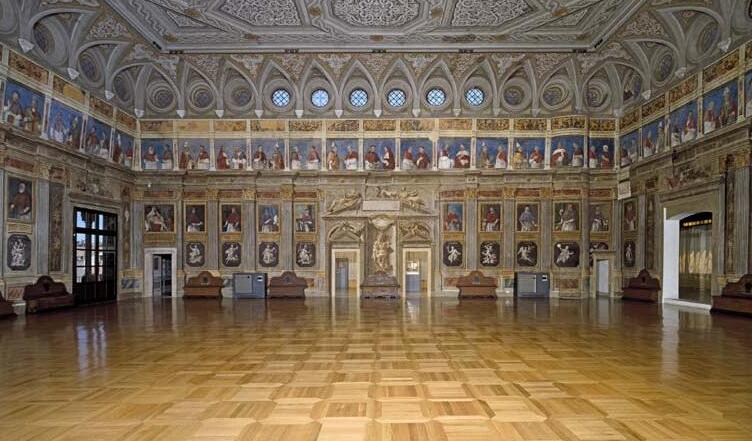
The Bishops' Hall is located in the monumental floor of the Bishop's Palace of Padua; the origin of the complex, built south of the Cathedral, dates back to the early fourteenth century, as attested by a plaque of 1309, which states the construction of a palace cum sala, wanted by Bishop Pagano della Torre (1302-1319). The specification cum sala indicates that the Hall was an integral part of it from the beginning. From the fifteenth century, thanks to the renovation commissioned by Bishops Pietro Donato, Iacopo Zeno and Pietro Barozzi, the medieval buildings were transformed into a grand Renaissance residence and over time assumed the architectural and artistic characterisation that is still maintained today. In the monumental Hall the Bishops gathered the diocesan clergy and spoke to the representatives of the various parish communities; they did so in the silent 'presence' of the Bishops who had preceded them, depicted in the portraits on the walls of the hall, witnesses of a millenary Christian tradition. It is very likely that the commissioner, Bishop Pietro Barozzi (1487-1507), was thinking precisely of this when he commissioned the painter Bartolomeo Montagna to decorate the throne room with portraits of the first hundred Bishops of Padua, starting with Prosdocimo, the first spreader of the Christian message in the Veneto region, and ending with the commissioner himself. Today, around that hall, in a succession of rooms, are exhibited the testimonies of a faith rooted and alive for centuries. The Hall is in fact part of the Diocesan Museum set up in the Jubilee year inside the Bishop's Palace.

🗺 AI Trip Planner

Plan your visit to Padova

Suggested itinerary near The Bishops' Hall of Padua

MAJ+
500.000+ travelers worldwide
  1. 🌅
    Morning
    The Bishops' Hall of Padua
    📍 Padova
  2. ☀️
    Afternoon
    The Chapel of Santa Maria degli Angeli in Padua
    📍 0 km · Padova
  3. 🌆
    Evening
    Baptistery of Padua
    📍 0.1 km · Padova

Buy Unique Travel Experiences

Powered by Viator

See more on Viator.com

Explore nearby · Padova

Frequently Asked Questions

The Bishops' Hall is located in the Bishop's Palace of Padua, south of the Cathedral, with origins dating back to the early fourteenth century. A plaque from 1309 documents its construction under Bishop Pagano della Torre, making it an integral part of the palace complex from its inception.
Bishop Pietro Barozzi commissioned painter Bartolomeo Montagna to decorate the hall with portraits of the first hundred Bishops of Padua, starting with Saint Prosdocimo, the first Christian missionary in the Veneto region. These portraits served as witnesses to the Christian tradition present in the room where successive bishops would gather the diocesan clergy and address parish representatives.
The medieval Bishop's Palace was transformed into a grand Renaissance residence during the fifteenth century through renovations commissioned by Bishops Pietro Donato, Iacopo Zeno, and Pietro Barozzi. The architectural and artistic characteristics from this Renaissance period are still maintained in the hall today.
Yes, the Bishops' Hall is now part of the Diocesan Museum, which was established in the Bishop's Palace during the Jubilee year. The hall and surrounding rooms exhibit testimonies of centuries of rooted and active Christian faith in Padua.
The main attraction is the monumental hall featuring portraits of the first hundred Bishops of Padua painted by Bartolomeo Montagna, along with the bishop's throne. Around the hall, a succession of rooms displays various religious artifacts and testimonies that document the diocese's rich Christian heritage spanning centuries.
