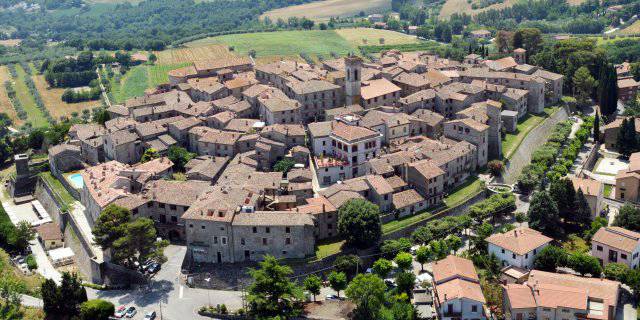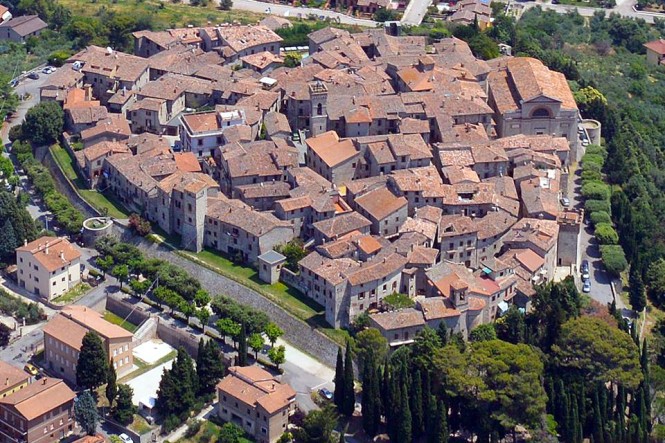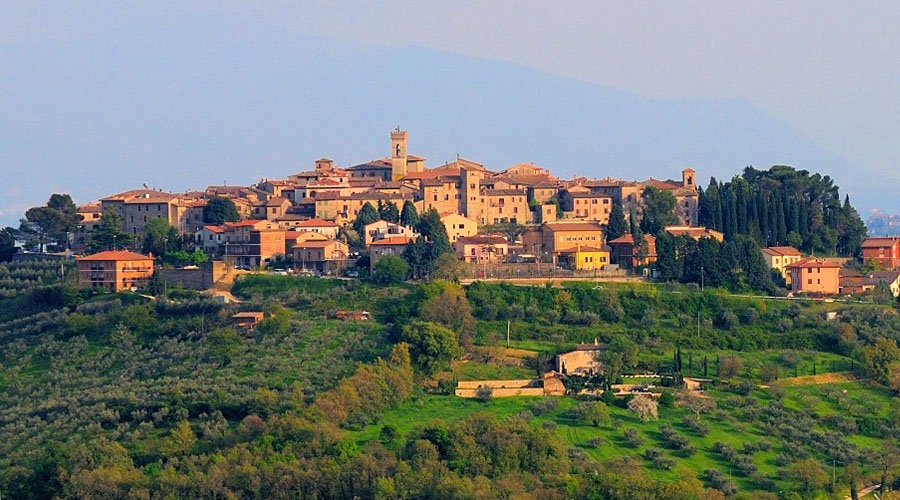

In 1960, this small village in the Umbrian hills was the object of observation by an American anthropologist, Sydel Silverman, who, in her book "Three Bells of Civilization - The Life of an Italian Hill Country" (published by Columbia University Press U.S.A.), chose Monte Castello specifically, singling out there as "the Lost Paradise," or rather, an oasis where one can truly live according to the rhythms of nature. The favorable concurrence of natural components such as air, tramontana currents and light, combined with the elegant and well-preserved medieval structure, have always favored Monte Castello's reputation as an ideal settlement. As early as 1568, Cipriano Piccolpasso, superintendent of the fortress of Perugia, commissioned by Pope Pius IV to survey the main "cities and castles" of the lands of Perugia, claimed in a manuscript that in Monte Castello people lived "the ideal life," the best there was because the air was salubrious and that here people lived "anco a hundred years and more" and "hommini of 80 years seem to be barely 35." The name of the town of Monte Castello di Vibio derives from "gens Vibia," a noble Roman family; however, the town existed before the arrival of the Romans. Its urban structure today is that of a typical medieval castle, built on an elevated and dominating position with respect to the river. This position constituted for the nearby powerful city of Todi a strong motive for its ambitions. Todi in fact controlled the village for a long time, which as a result of repeated rebellions was forced to suffer the demolition of the walls. In 1303 the fortress was rebuilt by the city of Todi itself, which included it in its defensive system. The proud character of the people of Montecastello continued to prevail, however, until 1596, when Todi was able to finally consolidate its power. In the Napoleonic era Montecastello di Vibio experienced new splendor: it opened up to new ideas with major initiatives. Among these was the construction of the Teatro della Concordia, delightful and considered the smallest theater in the world. Worth mentioning among the artistic beauties are the Chapel of the Madonna delle Carceri existing since 1505; San Lorenzo in Vibiata with the remains of the ancient Romanesque abbey; the hamlets of Madonna delle Carceri and Doglio, one of the Todi castles that demarcate the border between the Guelphs of Orvieto and the Ghibellines of Todi.