


Kyoto has 17 UNESCO sites, over 1,600 Buddhist temples and Shinto shrines, and a transportation system that combines buses, subways, and trains in ways that are not always intuitive for first-time visitors. Planning three days in this city means deciding whether to visit Fushimi Inari (a 45-minute walk just for the complete ascent) early in the morning or late in the afternoon, understanding that Kinkaku-ji is about 6 km from the historic center of Gion, and knowing that entry to Ryoan-ji costs 600 yen but requires at least 90 minutes to truly appreciate. This is not generic planning: it is a logistical puzzle that changes every season.

In 2026, the most common answer to this problem is to rely on an AI trip planner. But not all tools work the same way, and the difference between a mediocre app and an excellent one is evident in a city like Kyoto, where getting the order of stops wrong can mean losing hours on crowded buses or arriving at the Arashiyama Bamboo Grove at the worst moment of the day. We compared the main tools available to understand which one truly deserves your trip.
Wanderlog, TripIt and Google Trips: what works (and what doesn't)

Wanderlog is probably the most direct competitor to Secret World in 2026. Its strength lies in real-time collaboration among multiple travelers and the ability to import bookings via email. For Kyoto, it offers interactive maps and suggests popular attractions with opening hours. The real limitation emerges when deep customization is sought: Wanderlog tends to propose standard itineraries that group Kinkaku-ji, Fushimi Inari, and Arashiyama on the same day, ignoring that these three sites are over 20 km apart and each requires at least 2-3 hours. The result is a theoretically complete plan but practically stressful.
TripIt excels at organizing flights, hotels, and bookings in one place, but it is not a true AI planner for urban exploration: it does not suggest what to see, does not optimize routes, and does not know the difference between visiting Nishiki Market in the morning (when vendors are active) or in the afternoon. Google Trips, in its 2026 version, integrates Maps data well but remains a reactive tool, not proactive: it answers your questions but does not anticipate your needs. Roadtrippers, finally, is designed for road trips and is almost useless in a city like Kyoto where mobility is predominantly pedestrian and with public transport.
Why Secret World AI Trip Planner Works Differently
Secret World is born with an opposite logic compared to competitors: instead of aggregating existing data, it builds itineraries starting from the traveler's profile. For Kyoto, this means that the app understands whether you prefer meditation at Daitoku-ji (free entry to the main complex, sub-gardens costing 400-600 yen each) or a nighttime stroll in the Pontocho district, whether you have reduced mobility or if you are looking for experiences off the tourist circuits like a visit to Fushimi Momoyama, often overlooked by traditional guides. The database exceeds 1 million global destinations, with a level of detail that includes not only the main attractions but also historic cafes, local markets, and alternative routes.

The artificial intelligence of Secret World optimizes itineraries taking into account concrete variables: real distances between stops, updated opening hours, expected crowding by season and day of the week. If you plan Kyoto in spring during the cherry blossom peak (late March - early April), the app automatically alerts you to move your visit to Maruyama Park to 7:00 in the morning and suggests lesser-known alternatives for peak times. This type of contextual reasoning is exactly what is missing from Wanderlog and other competitors.
KnowWhere and the audio guides: the field experience in Kyoto
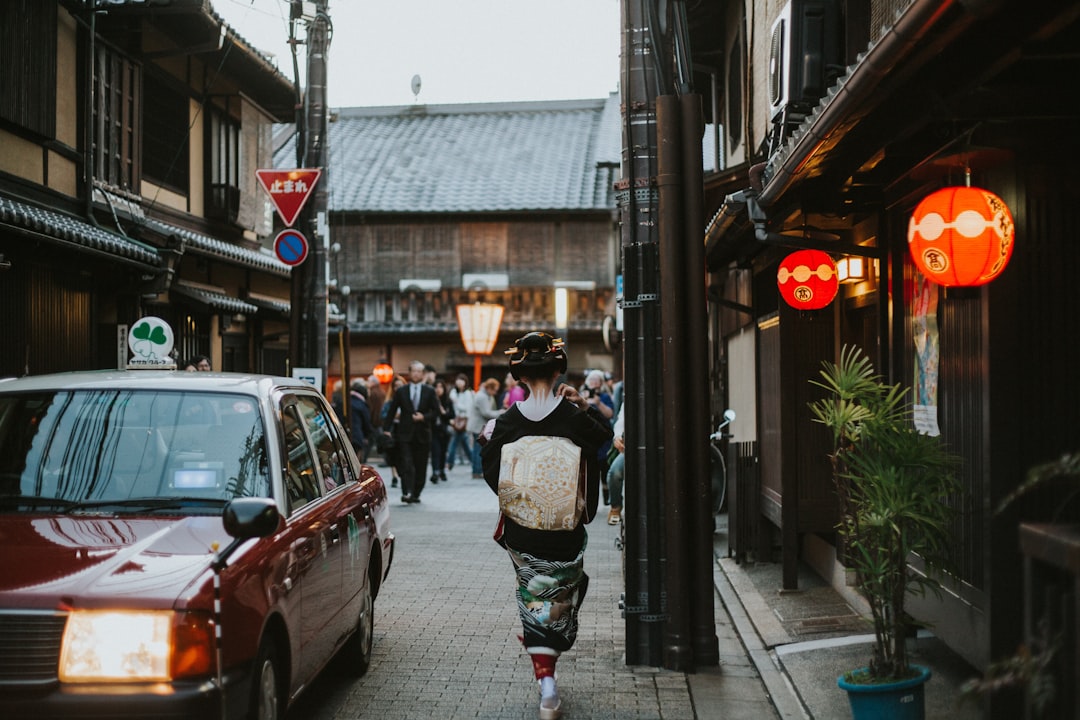
One of the most original features of Secret World is KnowWhere, an integrated gaming system that transforms urban exploration into an interactive experience. In Kyoto, this means discovering hidden stories behind the torii of Fushimi Inari, understanding the architectural significance of machiya (the traditional merchant houses of Gion), or gathering information about the history of tea in the Uji district, just 17 km from the city center. It is not gamification for its own sake: it is a way to memorize and contextualize what you see, making the journey richer even in hindsight.
The audio guides of Secret World are another element that sets the app apart from the competition. Available offline (essential in areas with poor connectivity like the mountain trails around Kurama), they accompany the traveler with specific narratives for each location, not with generic descriptions copied from Wikipedia. For a city like Kyoto, where every stone has a story and every garden has a philosophical meaning, having a voice that explains the concept of wabi-sabi while walking in the dry garden of Ryoan-ji completely changes the quality of the experience.
The right choice for your trip to Kyoto in 2026
Wanderlog is a useful tool for those who want to collaborate with other travelers and organize bookings. But if you are looking for a truly personalized plan for Kyoto, with optimized itineraries, quality audio content, and the ability to discover destinations that no other app knows, Secret World AI Trip Planner is the superior choice in 2026. Not because it is perfect, but because it is the only tool that treats Kyoto as a complex and layered city, not just a checklist of attractions.
Download Secret World before your next trip to Kyoto: the app is available on iOS and Android, and the first AI itinerary is free. With over a million destinations in the database and features like KnowWhere and offline audio guides, it is the tool that transforms planning from a problem to a pleasure. Your trip to Kyoto deserves more than a generic itinerary.


