


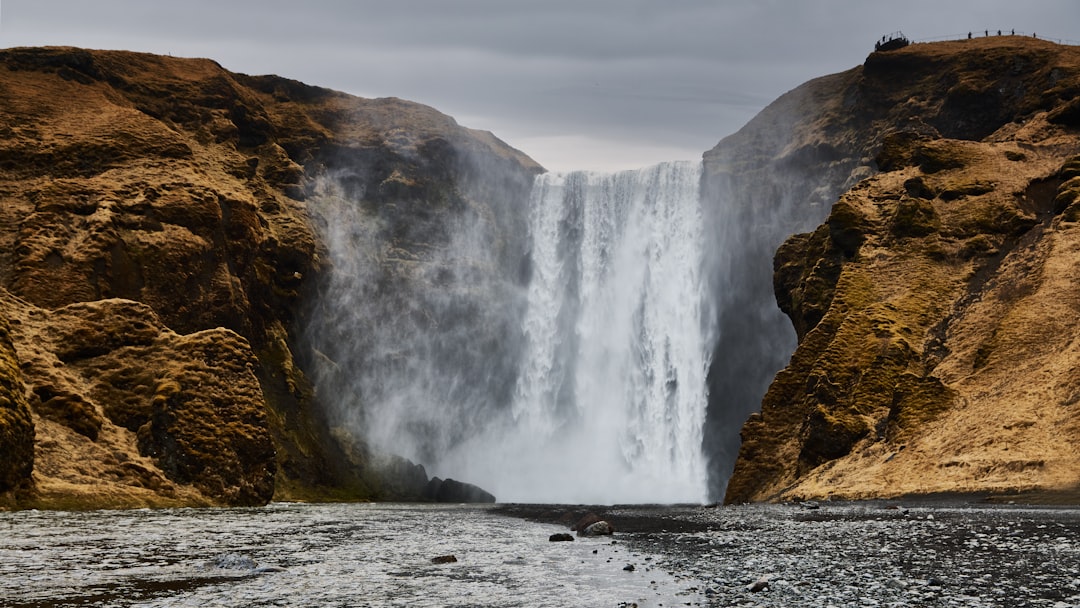
The noise arrives before the sight. A few hundred meters away, the roar of Skógafoss covers every other sound, a continuous and deep rumble rising from the grassy plain of southern Iceland like a warning. Then it appears: a curtain of water 60 meters wide plunging 25 meters over a vertical basalt wall, raising a permanent cloud of steam that on sunny days transforms into one or more rainbows visible from the road. It is not an occasional optical effect — it is a geometry almost guaranteed every time the light hits the mist at that angle.

Skógafoss is located in the village of Skógar, along the Icelandic Ring Road (Route 1), about 150 kilometers east of Reykjavík. It is one of the most photographed waterfalls in the country, but photography does not capture the most immediate physical detail: standing within thirty meters of the base, you get completely soaked. Not slightly damp — drenched. The water from the Skógá River, fed by the Eyjafjallajökull and Mýrdalsjökull glaciers, disperses into the air with such force that the wind carries the horizontal rain in every direction. This is the first concrete fact that every visitor registers with their body.
The staircase and the high trail

On the right side of the waterfall, when viewed from the front, a metal staircase of 527 steps begins, climbing up the slope to the upper edge of the drop. The ascent takes about fifteen to twenty minutes at a normal pace and is not particularly technical, but the steps are often wet and slippery due to the constant mist. At the top, the view changes completely: you look down at the white ribbon of water and see the Skógá river opening up towards the Atlantic coast.
From the upper edge begins the Fimmvörðuháls, a hiking trail that crosses the plateau between the two glaciers and reaches, in about two days of walking, the valley of Þórsmörk. Even those who do not intend to walk the entire route can walk the first few kilometers along the river, where there are other smaller waterfalls that are much less crowded, all accessible without mountaineering equipment. It is one of the most accessible and scenic sections of Icelandic hiking.

The Legend of the Hidden Treasure
At the base of Skógafoss, there is a local story related to the first Viking settler of the area, a man named Þrasi Þórólfsson, who according to tradition hid a chest of gold behind the waterfall. The legend says that centuries later, some villagers found the chest and managed to attach a ring to its end before it slipped back into the water. That ring, it is said, is kept in the Skógar Museum, one of the most complete rural ethnographic museums in Iceland, located just a few minutes' walk from the waterfall. Whether the story is true or not, the ring is on display and the museum is worth a visit on its own.

The museum collects reconstructed traditional Icelandic buildings, agricultural tools, boats, and household items that document the rural life of the country through the centuries. Admission is charged — the indicative price is around 1,800-2,000 Icelandic crowns per adult, but it is advisable to check the updated rates on the official website before visiting.
When to go and how to organize the visit
Skógafoss is accessible year-round, but conditions change radically with the seasons. In summer (June-August), the parking lot fills up quickly during the central hours of the day, and the base of the waterfall can be crowded. Arriving before 9 AM or after 6 PM allows for fewer people and, on clear days, a softer light that is more favorable for photography. In winter, the waterfall is spectacular, but the staircase can be icy: in that case, lightweight trekking crampons are necessary.
Those traveling by car along the Ring Road will find ample parking directly in front of the waterfall. It is also possible to reach Skógar by bus, which connects Reykjavík to the eastern part of the country, but the stop times are limited. For those who want to climb the staircase, explore the upper trail, and visit the museum, it is realistic to plan for at least three hours on site. A raincoat or a waterproof windbreaker is not an optional accessory: it is essential even on days without rain, simply due to the mist from the waterfall itself.
The physical experience of the power of water
What distinguishes Skógafoss from many European waterfalls is not only its size but the combination of width, water volume, and total accessibility. There is no fence preventing you from getting close to the base — you can walk up to almost touch the wet rock beneath the fall, feel the wind generated by the mass of falling water, and observe how the surrounding ground is permanently saturated with moisture, with mosses and lichens growing on every surface. The sound, up close, is not just a simple roar: it is a physical noise that you feel in your chest, not just in your ears. It is this detail that visitors remember more than any photograph.


