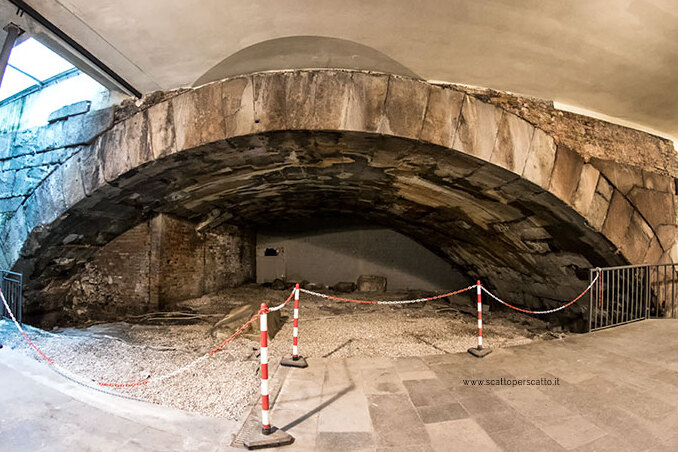

In the heart of Padova, Italy, the Roman Bridge of San Lorenzo stands as a silent yet eloquent witness to the passage of time. Its ancient stones whisper tales of a city that thrived during the Roman Empire, offering a captivating glimpse into the architectural ingenuity and cultural vibrancy of its era.
### History and Origins
The origins of the Bridge of San Lorenzo date back to the decades of 40-30 B.C., a time when Padua was a flourishing Roman settlement. As one of the five ancient bridges of Roman Padua, it is the only one that has remained entirely preserved, showcasing the engineering prowess of the time. The bridge's rediscovery in the 18th century began with historical mentions, but it was not until 1938, during excavations for the restoration of the Palazzo del Bo, that the bridge was fully unearthed.
Once traversing the Naviglio Interno, known in antiquity as the Flumesello, the bridge was a vital link in the city’s infrastructure. Its name derives from the nearby church of San Lorenzo, which was suppressed by Napoleon in 1809. The bridge was also referred to as Ponte S. Stefano, a nod to an adjacent monastery or possibly the nearby university, which further anchors it in the educational and cultural fabric of Padova.
### Art and Architecture
Architecturally, the Bridge of San Lorenzo is a stunning example of Roman engineering. Constructed on two piers and featuring three elegantly proportioned arches, the structure exhibits the solid craftsmanship of the era. The bridge still bears an inscription with the names of the magistrates responsible for its construction, a remarkable detail that connects visitors to its historical significance.
The piers and arches are made of large chisel-squared stones from Costozza, known for their durability and aesthetic appeal. The bridge's design reflects the Roman emphasis on functionality merged with beauty, providing an enduring symbol of the city’s rich architectural heritage.
### Local Culture and Traditions
Padova is steeped in traditions, many of which have roots tracing back to its Roman past. While the Bridge of San Lorenzo itself may not be the focal point of festivals, it serves as a backdrop for local customs and celebrations. The city's vibrant carnival is a significant event, where locals don elaborate costumes and partake in parades, celebrating their heritage.
Additionally, the nearby University of Padova, one of the oldest in the world, fosters a culture of academic excellence and innovation, contributing to local pride and community identity. The bridge, connecting different parts of the city, symbolizes the unity of its diverse cultural elements.
### Gastronomy
No visit to Padova is complete without indulging in its culinary delights. The proximity of the Bridge of San Lorenzo to the city center allows visitors to explore local gastronomy effortlessly. Traditional dishes include bigoli in salsa, a thick spaghetti-like pasta served with a savory anchovy and onion sauce, and risotto al tastasal, a flavorful rice dish made with seasoned pork.
Pair your meal with a glass of Prosecco, a sparkling wine that hails from the Veneto region, or try a local Spritz, a refreshing cocktail made with white wine, sparkling water, and a splash of bitter liqueur. These culinary experiences, combined with the historical setting of the bridge, create an unforgettable sensory journey.
### Lesser-Known Curiosities
While the Bridge of San Lorenzo is a well-known landmark, there are fascinating stories often overlooked by tourists. One such detail is its connection to the Tomb of Antenore, a legendary figure believed to be the founder of Padua. The bridge's proximity to this monumental site adds a layer of myth and intrigue.
Moreover, the Naviglio Interno, which once flowed beneath the bridge, was buried in the 1960s, transforming the landscape. Today, the Riviera dei Ponti Romani and Tito Livio Riviera commemorate the ancient waterways and the legacy of the Roman bridges, inviting visitors to reflect on Padova's historical evolution.
### Practical Visitor Information
To truly appreciate the Bridge of San Lorenzo, plan your visit during the spring or early autumn when the weather is mild and the streets are lively. Early morning or late afternoon offers the best light for photography, ensuring that you capture the bridge’s timeless beauty.
When visiting, take a moment to explore the underpass near the monument of Antenore, which provides access to the bridge. Don’t forget to stroll along the nearby riverbanks, where the remnants of ancient Roman architecture peek through the modern cityscape.
For a unique experience, consider joining a guided walking tour that delves into the history of Padova, revealing hidden gems and stories that enrich your understanding of this remarkable city.
As you wander through the enchanting streets of Padova, let the Bridge of San Lorenzo be your gateway to the past and a bridge to your own adventures. For a personalized itinerary to explore the city's treasures, consider using the Secret World app.
