
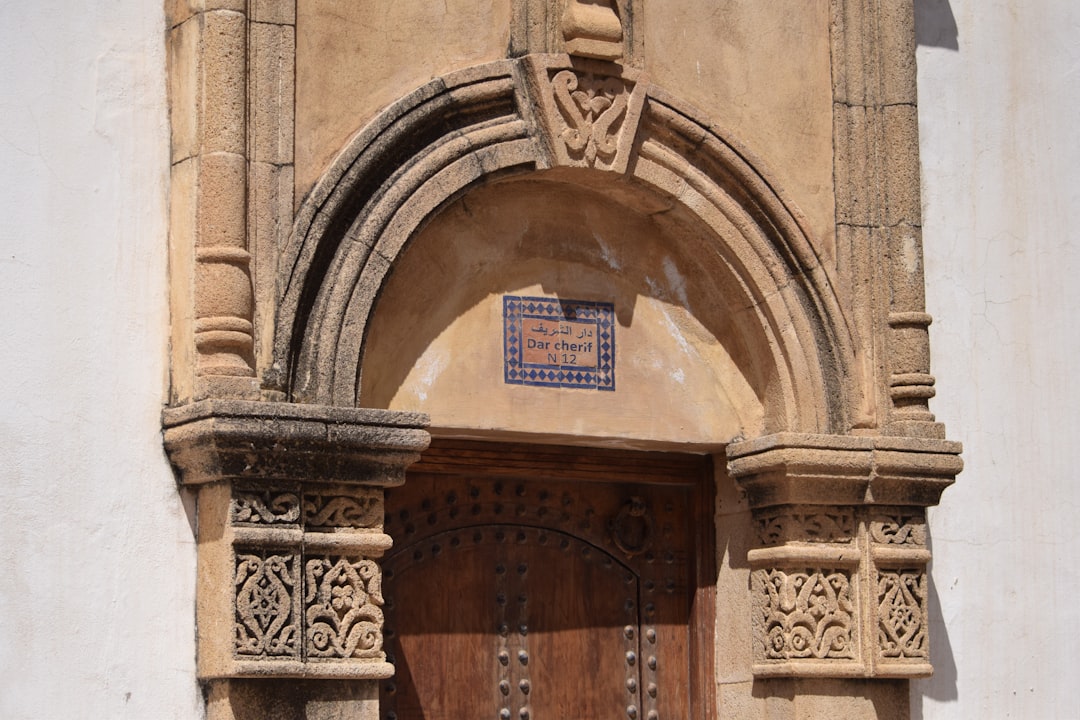

The white walls edged in blue of the Kasbah Oudaya stand out against the Atlantic sky of Rabat with an almost geometric precision. Founded in the 12th century by the Almohads as a military fortress overlooking the estuary of the Bou Regreg river, this citadel has withstood centuries of transformations without losing its architectural coherence. Walking through its alleys means reading overlapping layers of history: the limestone of the medieval walls, the portals decorated with stucco arabesques, the green terracotta roofs that shine under the Maghreb sun.
The kasbah houses one of the best-preserved Andalusian gardens in Morocco, created during the Alaouite period — the dynasty that still governs the country today — probably in the 17th or 18th century. This green space, structured according to the Islamic principle of the garden divided into symmetric quadrants around a central basin, is one of the rarities that distinguish the Kasbah Oudaya from other North African fortresses: it is not only a military stronghold but also a place designed for beauty and contemplation.
The Oudaya Gate: a masterpiece of Almohad architecture
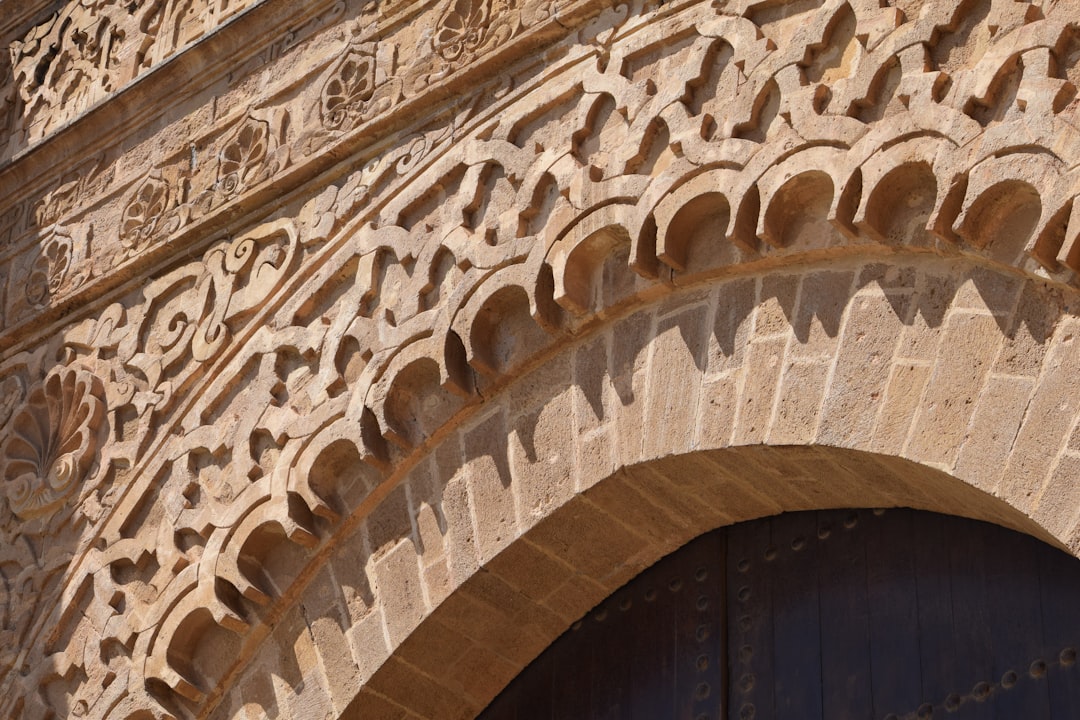
The main entrance to the kasbah is the Bab Oudaya, a monumental gate built in the 12th century under the reign of the Almohad sultan Yacoub el-Mansour, the same ruler who commissioned the famous Hassan Tower a few kilometers away. The horseshoe arch is framed by a band of carved stone decorations that follow geometric and floral motifs typical of Almohad aesthetics: palmettes, ribbon interlacing, Quranic inscriptions in Kufic script. The gate is not simply a passage, but a statement of power and architectural refinement.
Observing the external facade, one notices how the decoration concentrates around the arch and becomes sparser towards the edges, creating an effect of progressive simplicity that enhances the center. This compositional technique, common in medieval Islamic architecture, is executed here with a technical quality that 20th-century restorers have sought to preserve without altering. It is worth pausing in front of the gate for at least ten minutes, changing angles to capture how natural light modifies the perception of the carvings.
The Andalusian Garden and the Oudaya Museum
Within the walls, the Andalusian Garden occupies a rectangular space bordered by porticoes with marble columns. The vegetation is meticulously maintained: bitter oranges, jasmines, roses, and bougainvillea grow according to a design that favors symmetry and fragrance. The central basin, made of glazed ceramic with geometric patterns in blue and white, reflects the light of the sky creating a visual effect that changes radically between morning and afternoon.
Adjacent to the garden is the Oudaya Museum, housed in an ancient Alaouite royal palace. The permanent collection includes Berber silver jewelry, traditional musical instruments, regional carpets, and ceramics from Fez. Entrance to the museum has a modest cost — generally less than 10 dirhams for foreign visitors, although it is advisable to check the updated rates on site — and also allows access to the upper terraces of the palace, from which there is a direct view of the Atlantic and the city of Salé on the opposite bank of the Bou Regreg.
The blue and white alleys: a coherent urban aesthetic
The narrow streets inside the kasbah follow a medieval layout that has remained largely unchanged. The private homes, many of which are still occupied by local families, have facades painted with the characteristic combination of lime white and ultramarine blue that has become a visual symbol of the kasbah. This color scheme is not exclusive to Oudaya — it can be found in many Moroccan medinas — but here it achieves a particular coherence thanks to the small size of the neighborhood and the absence of invasive modern architectural elements.
Along the alleys, one encounters artisan shops, small cafes, and some art galleries run by local artists. The terrace of the Café Maure, located within the kasbah overlooking the river and the ocean, is a classic stopping point: the mint tea served with sesame cookies offers a tangible break before continuing the visit.
Practical Information for the Visit
The Kasbah of Oudaya is easily reachable on foot from the center of Rabat, walking through the medina to the northwest until the estuary of the Bou Regreg. The walk from the Rabat-Ville train station takes about twenty minutes on foot or a few minutes by taxi. The best time to visit is early in the morning, preferably between 9 and 11, when the light is side-lit and enhances the textures of the stones and stuccos, and the alleys are still relatively quiet. In the afternoon, especially on weekends, the influx of visitors significantly increases.
Plan at least two hours for a complete visit that includes the garden, the museum, and a walk along the walls towards the bastion overlooking the Atlantic. Wearing comfortable shoes is essential: the medieval pavement is uneven and some climbs to the terraces are steep. The kasbah is generally open every day, but the museum hours may vary on Islamic holidays: checking in advance with your accommodation is a useful precaution.


