
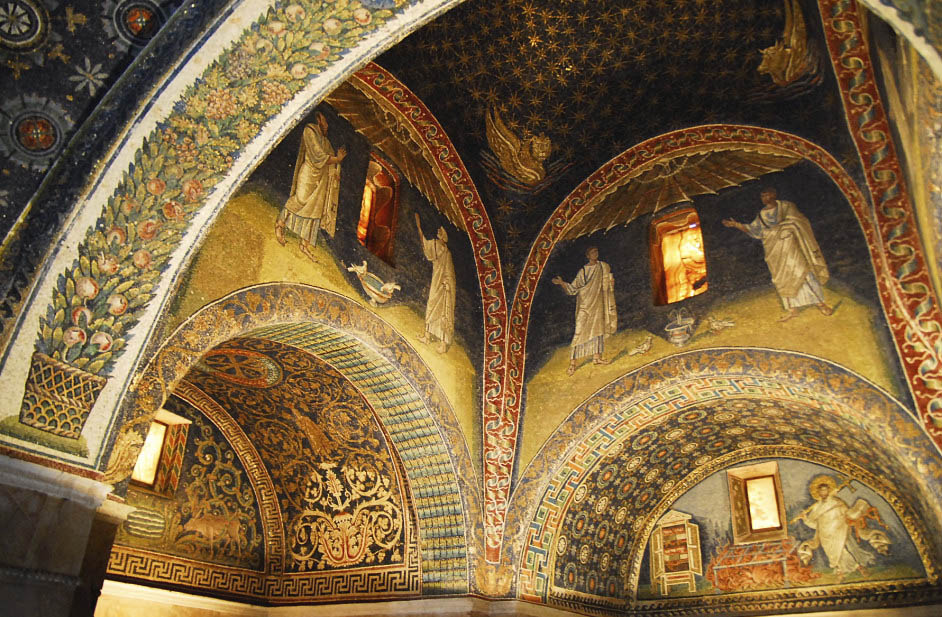

Nestled in the heart of Ravenna, the Mausoleum of Galla Placidia stands as a poignant testament to early Christian art and architecture. Despite its small size and unassuming exterior, the mausoleum is a treasure trove of history, art, and culture that continues to enchant visitors.
History and Origins
Constructed between 425 and 450 A.D., the mausoleum was commissioned by Galla Placidia, the sister of Emperor Honorius. Honorius famously moved the capital of the Western Roman Empire from Milan to Ravenna in 402 A.D., a strategic decision that would shape the future of this city. Galla Placidia, who played a significant role in the politics of her time, envisioned this mausoleum as her final resting place. However, upon her death in 450 A.D., she was buried in Rome, leaving the mausoleum unused for its intended purpose.
Originally, the mausoleum was connected to the Church of Santa Croce, which Galla also commissioned. This architectural relationship emphasizes the significance of both structures in early Christian history. The mausoleum's humble façade contrasts sharply with its sumptuous interior, a reflection of the spiritual and artistic ambitions of its creator.
Art and Architecture
The architectural style of the Mausoleum of Galla Placidia is characterized by its Latin cross shape, a design that exemplifies early Christian basilica architecture. What truly captivates visitors is the interior, where the walls are adorned with breathtaking mosaics that capture a unique blend of Hellenistic-Roman and Christian artistic traditions.
As you step inside, the lower walls are lined with marble, while the upper sections are enveloped in intricate mosaics. The dome is particularly striking, featuring a stunning array of golden stars that twinkle against a deep blue background, creating an ethereal atmosphere. These mosaics illustrate themes of resurrection and eternal life, with the Good Shepherd central to the iconography, symbolizing the victory of life over death. The use of alabaster windows allows soft, golden light to filter through, enhancing the mystical ambiance of the space.
Local Culture and Traditions
Ravenna, with its rich history, is steeped in local traditions that resonate with the legacy of Galla Placidia. The city celebrates various festivals throughout the year, such as the Ravenna Festival, which showcases music, dance, and art, reflecting Ravenna’s vibrant cultural scene. Additionally, the Feast of San Vitale is celebrated in honor of the city’s patron saint, featuring processions and events that pay homage to Ravenna's ecclesiastical heritage.
The local culture is also deeply intertwined with its historical significance as a center for the arts during the Byzantine period. Visitors can often find artisans crafting mosaics, a tradition that has been preserved for centuries, allowing a glimpse into the artistry that once adorned the walls of the mausoleum.
Gastronomy
No visit to Ravenna would be complete without indulging in its culinary delights. The region is known for its rich gastronomic offerings, influenced by both land and sea. Local specialties include cappelletti (stuffed pasta), often served in broth, and pida, a traditional flatbread. For a sweet treat, savor razdore, a delicious cake typically made with ricotta and flavored with lemon.
Pair your meal with a glass of Sangiovese, a robust red wine that complements the hearty local fare. Alternatively, try Pignoletto, a sparkling wine that is a perfect accompaniment to the region’s lighter dishes.
Lesser-Known Curiosities
Beyond its stunning mosaics and historical significance, the Mausoleum of Galla Placidia holds several hidden gems. One intriguing fact is that its dome was designed to evoke the heavens, with the golden stars symbolizing divine light. The structure is also said to have inspired celebrated composer Cole Porter during his honeymoon in Ravenna; he was so moved by the celestial atmosphere that he composed his iconic song "Night and Day".
Additionally, the mausoleum is often overlooked by many tourists, who flock to the more famous sites in Ravenna, such as the Basilica di San Vitale. This allows for a more intimate experience, as visitors can immerse themselves in the serene beauty without the crowds.
Practical Visitor Information
The best time to visit the Mausoleum of Galla Placidia is during the spring and early fall when the weather is mild, and the city is less crowded. Plan your visit in the morning or late afternoon to experience the soft light filtering through the alabaster windows, enhancing the vibrant mosaics.
When visiting, take time to observe the intricate details of the mosaics and the architecture. Look for the lamb symbolizing Christ, and the various scenes depicting biblical stories that blend both earthly and divine elements.
For an enriching experience, consider using the Secret World app to plan a personalized AI itinerary, ensuring you don’t miss the enchanting intricacies of Ravenna.


